Short answer: the 2025 California Electrical Code, based on the 2023 National Electrical Code, brings Article 230.85 into effect statewide on January 1, 2026. For one- and two-family dwellings, service equipment replaced or installed after that date must include an emergency disconnect at a readily accessible outdoor location. That changes the scope of most panel upgrades and new single-family services.
What the rule actually requires
The emergency disconnect has to do three things: disconnect all service conductors entering the dwelling at once, sit where first responders can reach it from outside, and carry markings they can read in a smoke-filled driveway.
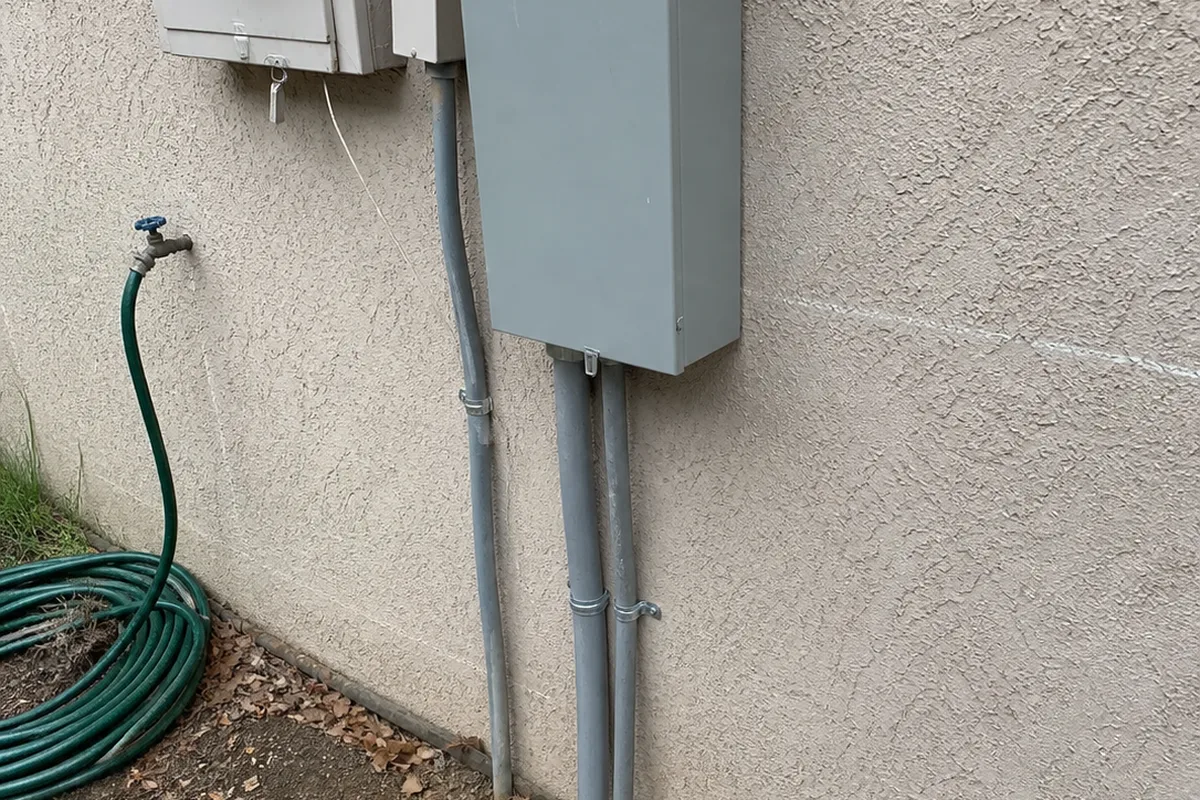
Under NEC 2023 Article 230.85, the disconnecting means must be located at a readily accessible outdoor location on or within sight of the dwelling unit. The NEC definition of “within sight” means visible and not more than 50 feet away. It can be locked, which matters if you are trying to keep it from getting tampered with, but it still has to be reachable from outside.
The equipment must have a short-circuit current rating equal to or greater than the available fault current from the utility. That is the same available fault-current calculation you already need for any new service, so the real change is the location and the labeling, not a brand-new calculation.
What the label has to show
NEC 2023 230.85(E) spells out the marking, and it is specific. The label must sit on the outside front of the disconnect enclosure with a red background and white text, and the letters must be at least 1/2 inch high.
The exact wording depends on what the disconnect is:
- A service disconnect must be marked “Emergency Disconnect, Service Disconnect.”
- A meter disconnect installed under 230.82 must be marked “EMERGENCY DISCONNECT, METER DISCONNECT, NOT SERVICE EQUIPMENT.”
- Any other listed disconnect on the supply side of the service disconnect must be marked “EMERGENCY DISCONNECT, NOT SERVICE EQUIPMENT.”
A generic red sticker from the supply house will not pass if it does not have the right wording and lettering height. Plan for field-applied labeling under 110.21(B), which means it has to be durable and properly applied, not taped on as an afterthought.
When it applies, and when it does not
The requirement applies to new installations and to service equipment replacement. If you are swapping in a new main panel or service disconnect for a one- or two-family dwelling, 230.85 now governs the job.
There is one important exception. Where only the meter socket, service entrance conductors, or related raceways and fittings are replaced, the emergency disconnect requirement does not apply. That means a straight meter-swap or service-line replacement does not automatically trigger an outdoor disconnect. A full panel or service-equipment replacement does.
How it changes your bids
Most of the cost is not the disconnect itself. It is the location, the enclosure, the labeling, and the coordination.
- Garage panels are no longer the default answer. If the existing panel lives inside the house or in a garage, the service disconnect now needs to be outside. A meter-main combo or an exterior disconnect enclosure adds material and labor to what used to be a straight panel swap.
- Meter-main combos are the easy path, but only if listed. A combination meter socket and main breaker can serve as the emergency disconnect if it is listed as suitable for use as service equipment. Do not assume every meter-main unit qualifies; check the labeling before you quote.
- Locked is fine, but plan access. The rule lets you lock the disconnect to keep people out. Make sure the homeowner knows where the key or combination is, or you will get callbacks during power outages.
- Other power sources need a directory. If the house has solar, battery, generator, or wind, and the isolation equipment for those systems is not right next to the emergency disconnect, you need a plaque or directory at the emergency disconnect showing where those other shutdown points are. The same directory logic shows up in Title 24’s EV-ready wiring requirements, another code change that adds a load nobody accounted for on the original panel.
What actually comes in on the phone
Watching how these calls come in, almost nobody says “service equipment replacement” or “meter disconnect under 230.82.” They say “my panel’s in that old wood box on the side of the house” or “the inspector red-tagged my meter and I need it fixed fast.” A dispatcher who doesn’t know to ask whether it’s the whole panel or just the meter socket can misbook a full service-equipment replacement as a quick meter swap, and the crew shows up short a disconnect enclosure and a label.
Wirewoman’s panel-upgrade intake already asks the two questions that decide whether 230.85 applies: whether the existing panel is indoors, in a garage, or already outside, and whether the scope is a full panel or service-equipment change versus a meter-only swap. That answer is on the job text before the truck leaves the shop, not discovered on site.
What to tell the homeowner when they call
Homeowners do not know this rule exists until it shows up on their bid. The conversation is straightforward: a panel upgrade or service replacement now requires an outside disconnect so firefighters can cut power without going inside. It is not an upsell, and it is not optional in most California jurisdictions once the 2025 code is in effect.
If they ask whether it applies to a simple meter repair, the answer is usually no. If they are replacing the panel or the main service equipment, the answer is yes.
What to verify before you quote
California adopts the NEC with state amendments, and local jurisdictions can add their own. Confirm which edition your AHJ is enforcing before you assume the 2025 code is live in that city or county. Also confirm whether the plan checker accepts a meter-main combo as the emergency disconnect or wants a separate disconnecting means. That single question changes the material list and the labor hours, the same way it does on any load calculation done under the 2026 NEC.
A consistent intake process can flag these questions before the truck rolls, so the quote is based on the right scope. A panel upgrade call that starts with “new construction or service replacement?” and “where is the existing panel located?” saves the on-site change order that kills the margin, the exact questions covered in what to ask before you book a panel upgrade.
While you are out at the service equipment, it is worth checking whether the job also touches an outdoor condenser or heat pump. The NEC 210.8(F) exception that let listed HVAC equipment skip GFCI protection expired September 1, 2026, so a service call that starts as a panel upgrade can turn up a second code question on the same trip.