Short answer: NEC 210.8(F) requires GFCI protection on outdoor outlets at dwellings. A temporary exception let listed HVAC equipment skip it, and that exception carried the words “This exception shall expire September 1, 2026.” That date is now here. Outdoor condensers and heat pumps at one- and two-family dwellings fall under the GFCI requirement, and because the code says outlets rather than receptacles, hardwired equipment is included. There is a pending amendment that would push the date to 2028, but it has not been adopted, so do not quote jobs as though it has.
What 210.8(F) actually says
California is enforcing the 2025 California Electrical Code, which is based on the 2023 National Electrical Code and took effect January 1, 2026. That is the edition your plan checker is working from, so it is the text that matters on your next permit.
The 2023 NEC language reads:
For dwellings, all outdoor outlets, other than those covered in 210.8(A), Exception No. 1, including outlets installed in the following locations, and supplied by single-phase branch circuits rated 150 volts or less to ground, 50 amperes or less, shall be provided with GFCI protection.
The listed locations are garages with floors at or below grade level, accessory buildings, and boathouses. The section also says that if equipment supplied by a covered outlet is replaced, the outlet has to be supplied with GFCI protection.
Note the thresholds: single-phase, 150 volts or less to ground, 50 amperes or less. A 240 volt residential condenser on a 30 or 40 amp circuit sits squarely inside that window. The 2026 NEC raises the ampere threshold to 60 amperes, but that edition is not what California adopted, so use 50 amperes when you are checking a job against the code in force here.
The word that catches people is “outlets”
This is where most of the field confusion lives. Plenty of electricians read 210.8(F) and assume it is about receptacles, so a hardwired condenser feels exempt by default. It is not.
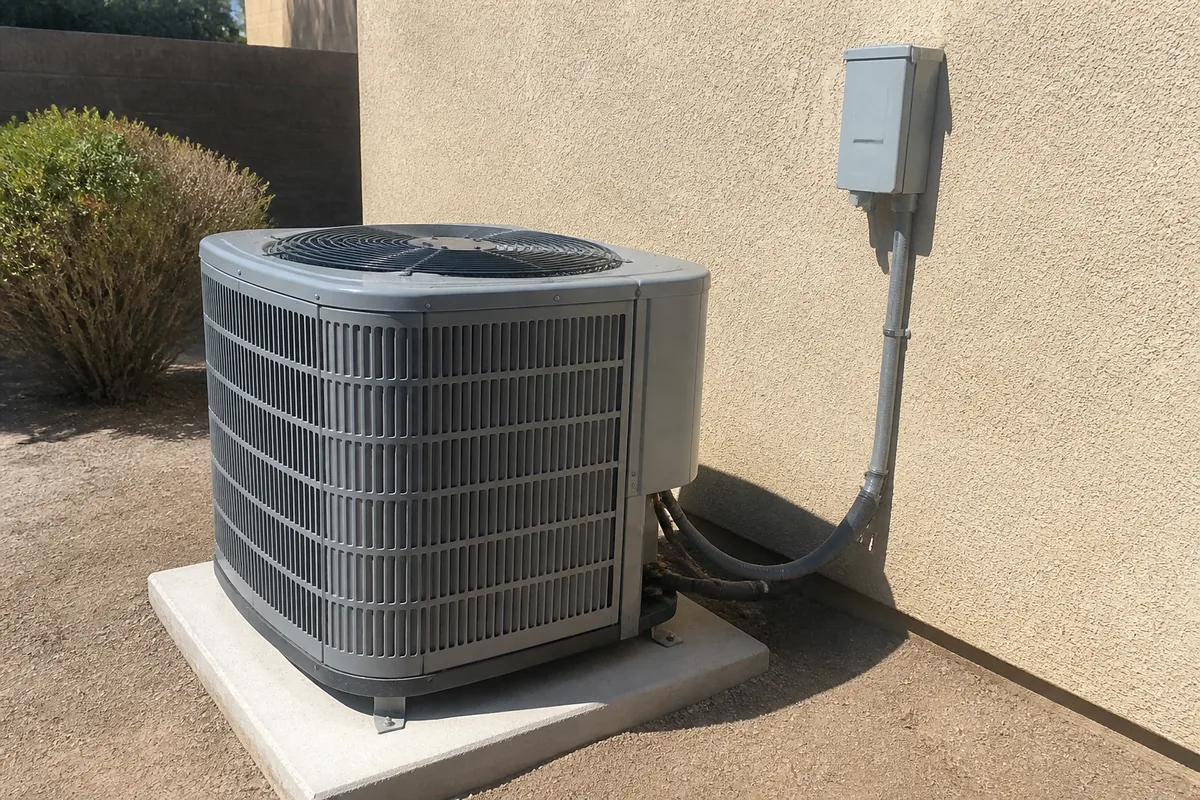
In NEC language, an outlet is a point on the wiring system where current is taken to supply utilization equipment. A receptacle is one kind of outlet. So is the point where the branch circuit lands at the disconnect serving an outdoor air conditioner. There is no plug involved and it is still an outlet.
That single definition is why 210.8(F) reaches outdoor HVAC at all, and it is why the exception had to exist in the first place. If the section had only ever covered receptacles, nobody would have needed to carve HVAC out of it.
What expired, and what did not
The 2023 NEC carries two exceptions to 210.8(F):
- Exception No. 1 says GFCI protection is not required on lighting outlets other than those covered in 210.8(C). This one has no expiration and is still in force.
- Exception No. 2 said “GFCI protection shall not be required for listed HVAC equipment. This exception shall expire September 1, 2026.”
Exception No. 2 is the one that just ran out. It was written with its own sunset date built into the code text, which is unusual, and it was there because HVAC equipment and GFCI devices were tripping each other in the field. The idea was to give manufacturers on both sides time to solve the compatibility problem.
The 2026 NEC adds a third exception that the 2023 edition does not have:
Listed Class C SPGFCI protection shall be permitted for listed HVAC equipment. If a Class C SPGFCI is provided, the disconnect serving the HVAC equipment shall be marked “Warning: Class C SPGFCI Protection Provided for HVAC Unit.”
Read that carefully before you lean on it. Exception No. 3 is a 2026 NEC provision. California’s code is built on the 2023 NEC, so the Class C path is not automatically on the table here. If you plan to use a Class C SPGFCI on a California job, ask the AHJ first instead of assuming the newer edition’s allowance applies.
The pending extension is not a reason to wait
The Air-Conditioning, Heating, and Refrigeration Institute submitted a Tentative Interim Amendment, TIA 1924, that would move the expiration from September 1, 2026 to September 1, 2028 across the 2020, 2023, and 2026 editions. The substantiation is that “more time is needed to develop products compatible to the GFCI requirements.” The Air Conditioning Contractors of America has publicly backed it.
Here is the part to keep straight: it is a proposal. NFPA put it into the public comment process with comments closing September 9, 2026. As of today it has not been adopted, and the code text in front of your inspector still says the exception expired.
So there are two real risks, pointing opposite directions. Quote a job as if the exception is still alive and you may eat a GFCI device and a return trip. Tell a customer the rule is permanent and it may get extended out from under you next month. The honest position with a homeowner is that the requirement is in effect now and a change is under review.
The nuisance-trip problem is the actual job risk
The reason this exception existed is worth understanding, because it is about to become your warranty callback.
A standard Class A GFCI trips at about 6 milliamps of ground fault current. Modern HVAC equipment with variable speed compressors and inverter drives produces high-frequency leakage current as a normal condition, not as a fault. Enough of it looks like a ground fault to a Class A device, and the unit trips on a hot afternoon with nothing actually wrong.
UL has been building out the device side to deal with this. UL 943C defines special purpose GFCIs in Classes C, D, and E with higher trip thresholds than Class A. UL describes Class C as covering circuits with no conductor over 300 volts to ground, using a layered approach that leans on the equipment grounding conductor, with a trip threshold above the Class A value. UL 943 also has an optional high frequency, or HF, marking for devices evaluated against loads that produce modern high-frequency leakage.
None of that helps you if the part is not in the truck. Before you commit to a compliance path on a bid, call your distributor and ask what is actually listed, actually stocked, and actually compatible with the specific condenser you are installing. Listed and available are two different questions.
How this changes your bids
- Condenser changeouts are the sleeper. The replacement language in 210.8(F) means swapping out equipment on a covered outlet pulls GFCI protection into the job. An HVAC company doing a straight changeout may hand you a scope that quietly now includes an electrical upgrade.
- Price the device, not just the labor. A GFCI breaker for a 240 volt two-pole circuit is a real line item, and an SPGFCI or HF-marked device is more. Do not absorb it into a flat disconnect price you set last year.
- Say who owns the callback. If the customer’s equipment nuisance trips, decide in writing whether that is your warranty or an equipment issue. This is the single most likely argument you will have in the next year.
- Coordinate with the HVAC contractor early. On new construction and changeouts, the equipment selection drives whether the protection is going to hold. Finding out at inspection is the expensive version.
- Check the panel. Not every load center has a two-pole GFCI breaker available in the right frame, and older panels may not have any listed option at all. That turns a disconnect job into a panel conversation.
- You may already be out there for a different code reason. California’s new outdoor emergency disconnect requirement sends electricians to the same exterior service equipment on plenty of panel-replacement jobs. Worth checking both boxes on the same trip instead of two separate site visits.
What to verify before you quote
Confirm which edition your authority having jurisdiction is enforcing. California is on the 2025 CEC and the 2023 NEC base, but adoption details and local amendments vary, and jurisdictions can be more restrictive than the state baseline. Ask your plan checker two specific questions: whether they are enforcing the expiration as of September 1, and whether they will accept a Class C SPGFCI given that the allowance lives in an edition California has not adopted. Those two answers change your material list.
Also ask whether they intend to honor TIA 1924 if it is issued. Some jurisdictions will pick up a TIA quickly and some will not touch it until the next adoption cycle.
What to tell homeowners who call
Most of these calls will arrive as “my AC keeps shutting off” or “the HVAC guy says I need an electrician.” Neither caller knows a code section changed.
The plain version: outdoor air conditioners and heat pumps at houses now need ground fault protection, the same kind of protection already on your bathroom and kitchen outlets, and it applies when the equipment is installed or replaced. It is a code requirement, not an upsell.
Getting that story straight on the first call saves the site visit that turns into a change order. An intake process that asks whether this is a repair, a changeout, or new equipment, and whether an HVAC contractor is already involved, tells you before the truck rolls whether you are quoting a disconnect or a panel job. That is the difference between a scoped bid and a guess.