Short answer: on January 1, 2026 Cal/OSHA’s confined space rules for construction changed in two ways that matter more than the coverage suggests. First, construction work was deleted from the list in section 5156(b)(2), which means the General Industry rule you probably built your program around, section 5158, no longer applies to your jobs at all. Article 37 of the Construction Safety Orders is now the entire rulebook. Second, “entry employer” was redefined. It used to turn on whether you decided your employees would enter. It now turns on whether they enter. If you are a C-10 who opens underground pull boxes, transformer vaults, crawlspaces, or attics, both of those land on you.
Article 37 itself is not new, and most of the coverage of this change gets that part wrong.
What actually happened, with dates
The rulemaking is called “Confined Spaces in Construction Clean-up.” The Occupational Safety and Health Standards Board voted to adopt it on September 18, 2025. It was filed with the Secretary of State on November 4, 2025, and it took effect January 1, 2026.
It amends six sections of the Construction Safety Orders, 1951, 1952, 1953, 1955, 1956, and 1960, plus section 5156 of the General Industry Safety Orders.
Note that last one. Nearly every writeup of this change describes it as amending “sections 1951 through 1956.” That misses 1960, which is rescue, and it misses 5156, which is the scope change that decides which standard you are on in the first place. Those are the two most consequential pieces.
Also worth being precise about: Article 37 was filed and became operative on December 30, 2015. Headlines calling this a “new Cal/OSHA standard for confined spaces in construction” are describing an eleven-year-old article. What is new is a set of amendments to it, and the removal of the parallel rule that used to run alongside it.
The scope change is the one to act on
Before January 1, section 5156(b)(2) read that the confined space definition and the requirements of section 5158, Other Confined Space Operations, applied to a list of operations. Item (A) on that list was:
(A) Construction operations regulated by Section 1502;
That item is deleted. Agriculture moved up from (B) to (A), marine terminals from (C) to (B), and so on down the list.
The practical effect is that construction work is no longer sitting under two standards at once. It used to be under both section 5158 and Article 37 concurrently, which is exactly the duplication a contractor at the November 2024 hearing described as confusing, having drafted programs under 5158 before 2015. Now it is Article 37 only.
If your written confined space program cites 5157 or 5158, references “Other Confined Space Operations,” or was adapted from a general industry template, it is written against a standard that no longer reaches your construction work. That is not a formatting problem. The two standards do not impose identical duties, and the one you are actually inspected against is the one in the Construction Safety Orders.
One caution before you throw the general industry version away. Article 37 applies to construction work. Work that is not construction work stays under the General Industry Safety Orders. The line between a repair and routine maintenance is not always obvious on a service call, and it now decides which rulebook you are on. If your shop does both, you need both, correctly labeled.
“I never decided they would go in” stopped working
The old definition in section 1951 read that an entry employer is “any employer who decides that an employee it directs will enter a permit space.” It carried a NOTE underneath it saying an employer could not avoid the standard’s duties by refusing to decide, and that the Division would treat the failure to decide as an implicit decision to allow entry.
The adopted text deletes that NOTE and rewrites the definition itself:
Entry employer means any employer whose employees enter or will enter a permit space.
Read what moved. The old rule hung the duty on an employer’s decision and then used a note to close the obvious loophole. Notes are unenforceable in California, which made that a weak patch. The new definition drops the decision entirely. You are an entry employer because your people go in the hole. What you decided, documented, or intended is no longer part of the test.
For a small shop this is the single most expensive line in the rulemaking. The informal arrangement where nobody quite authorizes the vault entry, the apprentice just does it because the conductor has to get pulled, is now the fact pattern that makes you an entry employer with a written program obligation under section 1952(d).
And “entry” is broad. Section 1951 defines it as occurring “as soon as any part of the entrant’s body breaks the plane of an opening into the space, whether or not such action is intentional or any work activities are actually performed in the space.” Leaning head and shoulders into a pull box to land a conductor is entry. You do not have to climb down a ladder to trigger this.
You now owe surveys, not just answers
Section 1952(a) used to be one sentence: before beginning work, each employer ensures a competent person identifies all confined spaces where its employees may work and identifies which are permit spaces.
It has been split into four affirmative duties:
(1) The employer shall have a competent person conduct an initial survey of its work area for confined spaces existing at the time work begins.
(2) The employer shall have a competent person inspect its work area with sufficient frequency to effectively identify new confined spaces.
(3) The employer shall inform their employees and the controlling contractor of each new confined space discovered or created as a result of construction or demolition activity.
(4) The employer shall have a competent person identify each confined space that is a permit space, through consideration, evaluation and testing of the elements of that space.
Four things changed in substance here.
The initial survey is now a named deliverable. Not a conclusion you reached, a survey a competent person conducted of your work area. That is the kind of requirement that gets proven with a record or not at all.
Paragraph (2) creates an ongoing obligation. The proposal originally said “periodically.” A modification in August 2025 struck that word and replaced it with “with sufficient frequency to effectively identify new confined spaces.” That is deliberately performance-based. There is no interval to comply with, which means there is also no interval to hide behind.
Paragraph (3) makes you a reporter, not just a recipient. Spaces created by construction or demolition activity are exactly what happens on a job in progress. A slab poured with a vault box, a wall closed up leaving a dead attic, a trench boxed and covered. When your crew finds or creates one, you tell your employees and you tell the controlling contractor. In writing, if you want to be able to prove it.
Testing became mandatory rather than conditional. The old text said permit spaces were identified “through consideration and evaluation of the elements of that space, including testing as necessary.” The adopted text says “through consideration, evaluation and testing.” The August modification explains why: to clarify that testing is necessary to distinguish a confined space that is not a permit space from one that is. If you want to call a space non-permit, you test to establish that. Your judgment is no longer the whole record.
Why an ordinary electrical vault is usually a permit space
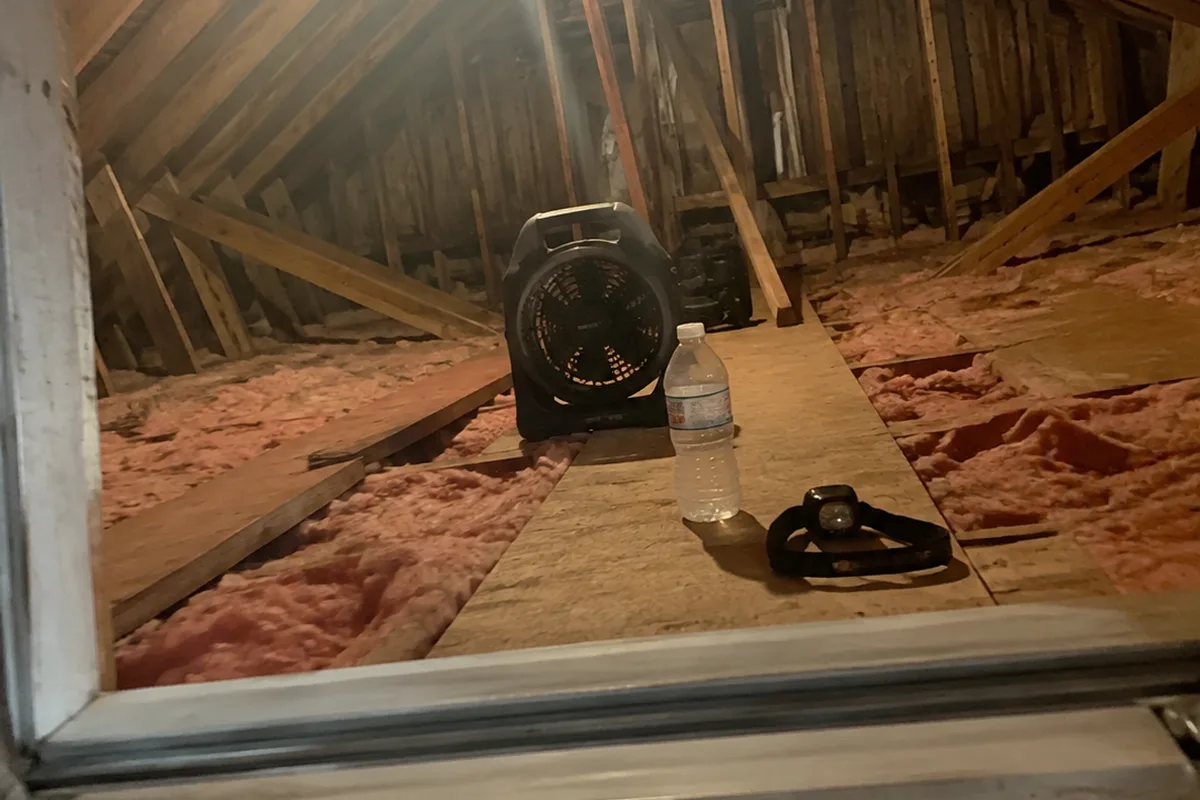
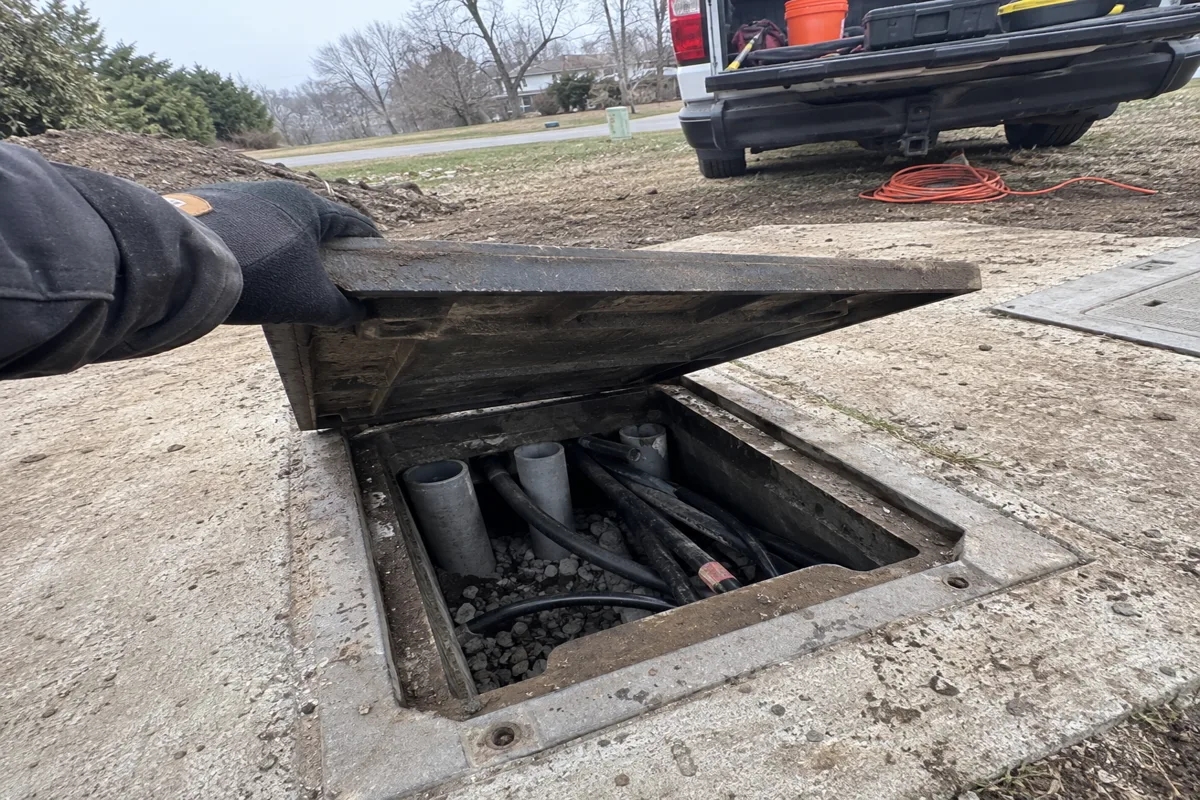
Section 1951 keeps the familiar three-part definition of a confined space: large enough to bodily enter, limited or restricted means of entry and exit, and not designed for continuous employee occupancy. An underground pull box, a transformer vault, a manhole, most crawlspaces, and plenty of attics satisfy all three without argument.
A confined space becomes a permit-required confined space if it has any one of four characteristics. Everyone remembers the first three, hazardous atmosphere, engulfment, and inwardly converging walls. The fourth is the one that catches electrical work:
(4) Contains any other recognized serious safety or health hazard.
Energized equipment in a below-grade vault is a recognized serious safety hazard. So is standing water over unknown conductors, so is a space you cannot get an injured person out of without a retrieval system. The atmosphere in a dry vault may be perfectly fine and the space can still be a permit space on characteristic (4) alone. Shops that test the air, get a clean reading, and conclude “not a permit space” are only answering one of the four questions.
The arc and spark prohibition nobody is quoting
Section 1953(a)(3) gained two new subsections that did not exist before. The first should stop any electrician who reads it:
(I) Prohibiting work involving the use of flame, arc, spark, or other source of ignition within a permit space (or any adjacent space having common walls, floor, or ceiling with the permit space) which contains, or is likely to develop, a hazardous atmosphere due to flammable or explosive substances, or contains, or is likely to develop an oxygen enriched atmosphere; and
(J) Conducting surveillance of the surrounding area(s) to avoid hazards such as drifting vapors from tanks, piping, and sewers.
Subsection (I) reaches further than hot work. An arc is an arc. Making or breaking a connection, a grinder, a drill motor that is not rated for the location, all of it is covered where a flammable atmosphere exists or is likely to develop. And the prohibition extends to an adjacent space sharing a wall, floor, or ceiling, which on a below-grade job means the vault next door and the sewer line running past it.
Subsection (J) is the reason for that. Vapors drift. A vault that tested clean at 7 a.m. is not a vault that is clean at 2 p.m. once someone opens a line upstream.
A real practical improvement, and a real new obligation
Two changes worth pricing in opposite directions.
The multi-gas meter is now expressly allowed. Sections 1952(e)(2)(C) and 1953(a)(5)(C) both gained the same sentence: “Concurrent testing for atmospheric hazards may be conducted with a multi-gas meter, provided the order in which readings are examined is preserved.” The required order stays oxygen first, then combustible gases and vapors, then toxics. What changed is that you no longer have to pretend a four-gas meter samples sequentially. You read the results in order. This is Cal/OSHA catching up with the instrument every crew already owns.
Rescue got a hard duty attached to it. Section 1960 was renamed “Permit Space Rescue and Emergency Medical Services” and gained a new subsection (a):
(a) The entry employer shall ensure the rescue services at the site are trained, immediately available, properly equipped, and capable of performing permit space rescue and obtaining emergency medical services specified under Section 1512(e).
The old structure put duties on an employer who designates a rescue service. The new (a) puts an affirmative duty on the entry employer to ensure adequate rescue exists at the site, before anyone goes in. The Board explained “immediately available” as reflecting the attributes of a rescue service, and confirmed that a non-entry retrieval system operated by an attendant counts as rescue service.
“We will call 911” has never been a compliant rescue plan for a permit space, and it is now measured against an explicit standard that a two-person crew with no tripod and no retrieval line will not meet.
Smaller changes that will still cost someone
- Combustible dust threshold moved. A hazardous atmosphere from airborne combustible dust used to be a concentration that “meets or exceeds its LFL.” It is now one that “exceeds 20 percent of the minimum explosive concentration (MEC),” and MEC is newly defined in 1951. The old note letting you approximate it as dust obscuring vision at five feet was deleted. Rule of thumb replaced with a measurement.
- Lockout and tagout now require an “effective” procedure, not an “established” one. The Board rejected a request to make it say “written.” Having a procedure on paper is not the test. Whether it works is.
- A note became enforceable text. The old NOTE under 1953(a)(3)(D) about inerting a space you cannot get below 10 percent LFL is now numbered regulatory text at 1953(a)(3)(D)(1), with three conditions: the space is rendered inert for the duration of entry, employees get respiratory protection under section 5144(d)(2) for IDLH atmospheres, and all additional physical hazards are eliminated or isolated. The Board’s stated reason for the conversion is blunt and worth remembering generally: “Notes are unenforceable in California.”
- Training has to produce understanding of specific things. Section 1956 now lists them: the written procedures, the hazards in the permit space, and the methods used to isolate, control or protect employees. Separately, employees not authorized to perform entry rescues shall be trained in the dangers of attempting unauthorized rescues. That last one exists because untrained would-be rescuers are a large share of confined space fatalities.
Verify this against the rulemaking record, not the section pages
Here is a genuine trap. As of this writing, the state’s own regulation pages at dir.ca.gov have not caught up. Section 5156 still prints “Construction operations regulated by Section 1502” as item (A) of subsection (b)(2), with agriculture at (B), which is the pre-2026 numbering. Section 1952 still prints subsection (a) as a single undivided sentence, with an amendment history ending in 2015.
If you look up either section on the state site today, you will read the old rule and conclude nothing changed. The authoritative version of what took effect is the adopted text approved by the Office of Administrative Law, linked in the sources below.
One thing not to over-read while you are in there. The 5156 amendment also deleted a NOTE that pointed to the High Voltage Electrical Safety Orders for electric utility operations in underground vaults. That deletion was housekeeping, part of stripping unenforceable notes out of the section, and it does not move utility vault work anywhere. Sections 2700, 2943, and 2943.1 still say what they said.
What to do this week
- Pull your written program and search it for “5157” and “5158.” If either appears as the governing standard for your construction work, it needs rewriting against Article 37, not editing.
- Name your competent person and give them a survey form. Section 1952(a)(1) and (a)(2) are proven with records. A one-page survey per job, dated, is the cheapest compliance you will buy this year.
- Decide your permit-space call on all four characteristics. Especially characteristic (4). Write down why a space is not a permit space, and support it with a test result, not a recollection.
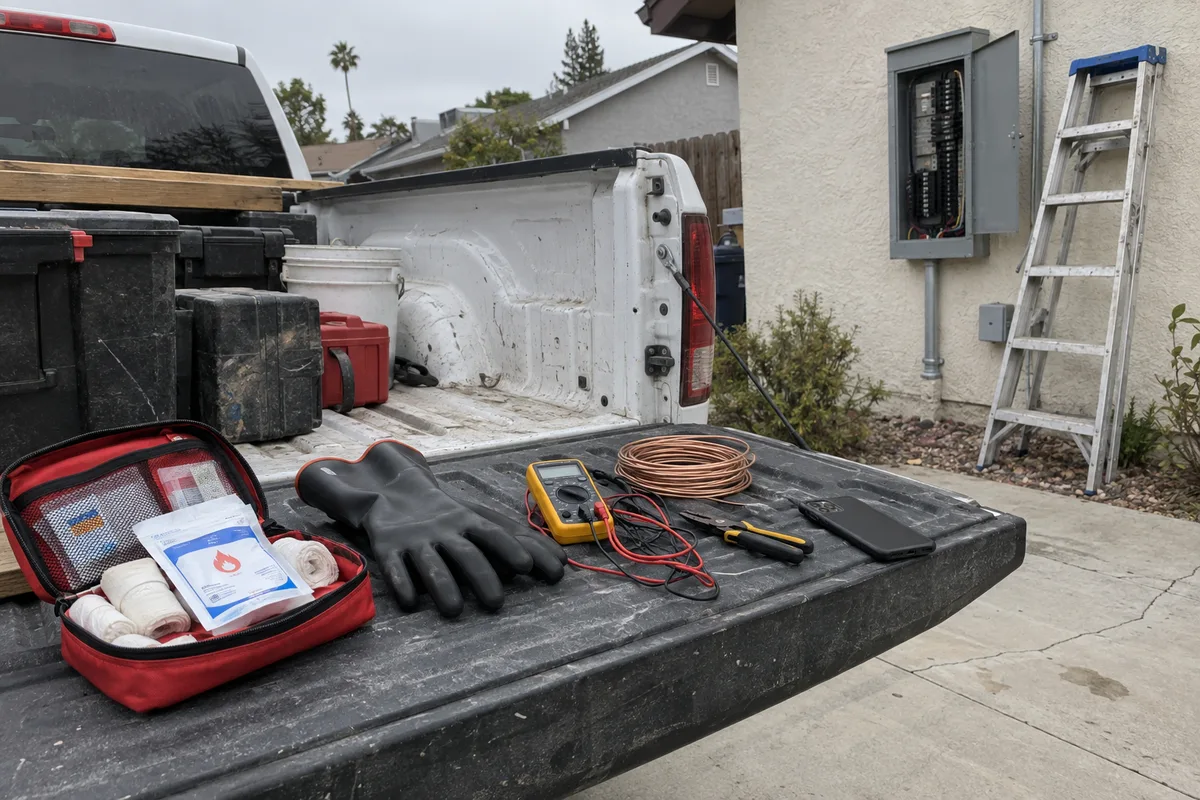
- Price rescue into vault and manhole work. Tripod, retrieval line, full-body harness, an attendant who stays outside and does nothing else. If that is not in your below-grade number, your below-grade number is wrong.
- Fix the adjacent-space blind spot. Subsection (I) reaches the vault, box, or room sharing a wall. Your survey has to look next door.
- Train on unauthorized rescue. It is now an explicit training subject, and it is the one that saves the second life.
Cal/OSHA penalties do not care that the rule moved sections. The penalty schedule for California electrical contractors is what a stale program gets measured against, and confined space citations are usually classified serious. This is the same pattern as the rewritten lead standard, where the trap was working from the federal numbers, and the same crawlspaces and attics that the indoor heat rule already reaches.
What to tell the people who call you
Nobody calls you about confined spaces. They call about a light circuit in the crawlspace, a pump in a below-grade vault, a shared service in an apartment building where the gear is in a basement room, a landscape lighting run where the splices are in an underground box that is full of water.
The plain version for a customer, when it changes their schedule or their price: some spaces have to be tested and attended before anyone goes in, that is a state worker-safety requirement rather than an upsell, and it changes how many people show up and how long the job takes.
What decides your cost here is whether you know before the truck rolls. Below grade or not, how the space is entered, whether anyone can stand up in it, whether there is standing water, and whether the gear is energized are five questions that turn a one-person service call into a two-person permit entry with a tripod in the bed. Ask them on the phone and you have priced the job. Find out in the parking lot and you are either eating the cost or telling a customer you have to come back, which is the same conversation that makes panel upgrade calls unprofitable when the intake is thin.