Short answer: California has two heat standards, not one. Title 8 section 3395 covers outdoor work and most electricians know it exists. Title 8 section 3396 covers indoor work, took effect July 23, 2024, and applies at 82 degrees Fahrenheit. An attic, a crawlspace, an unconditioned garage and a van whose air conditioning does not work are all indoor places of employment under the definition the regulation actually uses. The exception people rely on, the one that lets you ignore short exposures, stops at 95 degrees. Attic work in September is exactly where that matters.
The rule you probably skipped
When section 3396 was approved on June 20, 2024 and went into effect on July 23, 2024, the coverage framed it as a warehouse and factory rule. Restaurants, distribution centers, laundries. If you run a small electrical shop, you likely read a headline, decided it was about somebody else’s business, and went back to work.
The regulation does not describe itself that way. Subsection (a) applies it to all indoor work areas where the temperature equals or exceeds 82 degrees Fahrenheit when employees are present. There is no industry list and no square footage floor. The only question is whether the space is indoor.
What counts as indoor
This is the whole argument, so it is worth quoting. The standard defines indoor as:
a space that is under a ceiling or overhead covering that restricts airflow and is enclosed along its entire perimeter by walls, doors, windows, dividers, or other physical barriers
Cal/OSHA’s own FAQ adds that the barriers count “whether open or closed,” and that generally any facility with a roof and enclosed sides qualifies. It also draws the line on the other side: “partial structures such as lean-tos and structures with one or more open sides are outdoor workplaces.”
Now apply that to where you actually spend your day.
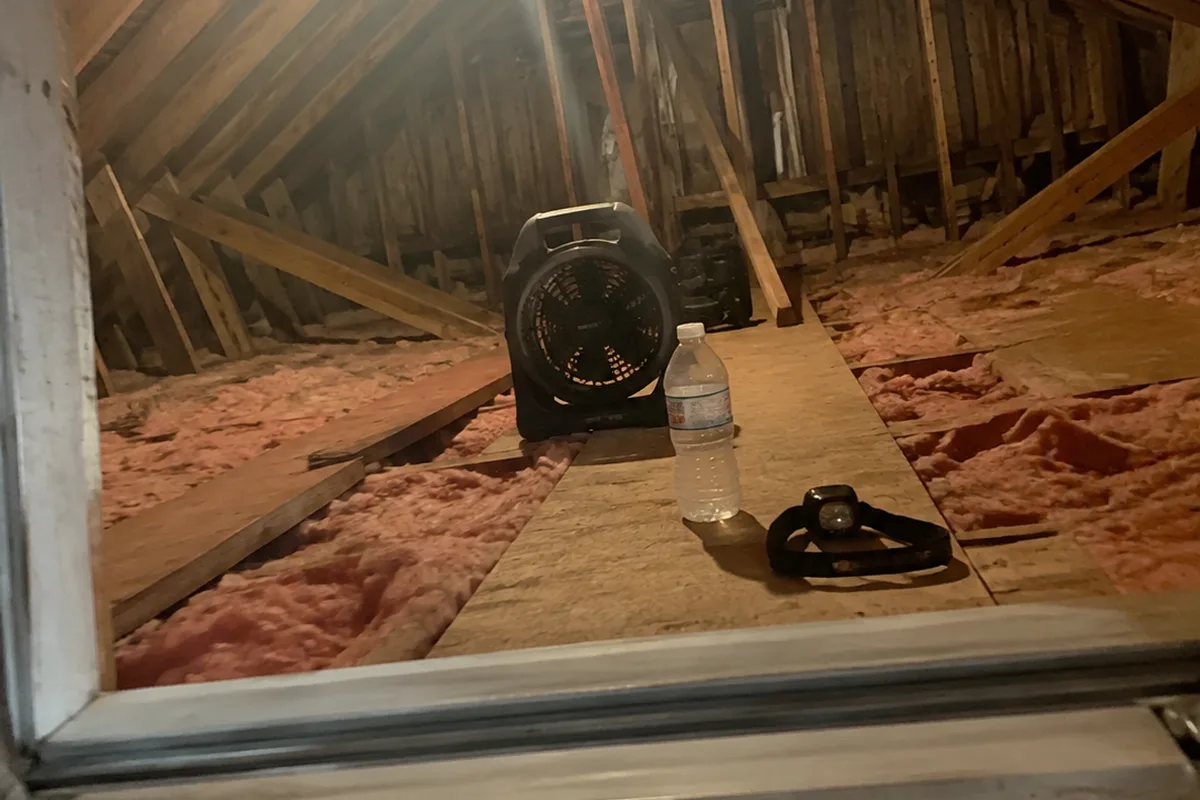
An attic is under a roof that restricts airflow and is enclosed on every side by the roof planes and gable walls. Soffit and ridge vents are openings in an enclosed perimeter, not open sides. It is not a lean-to. It is indoor.
A crawlspace is under the floor assembly above it and enclosed around its perimeter by stem walls. Foundation vents do not turn it into a partial structure any more than a window turns a garage into one. It is indoor.
An unconditioned garage, a detached shop, a pump house, a rooftop mechanical penthouse, an equipment room all clear the definition without difficulty.
Be honest about the limits of this. Cal/OSHA has not published an attic-specific or crawlspace-specific answer that I can point you to, so what you have above is the definition applied to your work, not a citation you can wave at an inspector. It is also not a close call. If someone tells you attics are outdoor work because there is a vent in the gable, ask them which words in the definition they are relying on.
The one genuinely hard case is a house under construction. A framed and roofed structure with wall openings but no windows hung is still enclosed by physical barriers, so it reads as indoor. A structure with an entire side not yet framed reads closer to the partial-structure language. When you cannot tell, measure. Measuring is cheaper than being wrong.
The exception that runs out
Here is the part that catches electricians, because it looks like it solves the problem and then does not.
Section 3396 exempts incidental heat exposure. In the regulation’s words, exposure to temperatures at or above 82 degrees and below 95 degrees for less than 15 minutes in any 60-minute period. That sounds tailor-made for the trade. You go up into the attic, pull a run, come down. Twelve minutes. Exempt.
Read the ceiling on it again. The exception only exists between 82 and 95 degrees. At 95 degrees and above there is no incidental exposure exception at all. A four-minute trip into a 118 degree attic is fully covered by the standard. The brevity of the visit stops mattering at exactly the temperature where brevity started to matter to your body.
There are two more carve-outs from the exception worth knowing, and one of them is parked in your driveway. The incidental exposure exception does not apply to vehicles without effective and functioning air conditioning, and it does not apply to shipping or intermodal containers during loading, unloading or related work. A service van with AC that died in June is not a vehicle with effective and functioning air conditioning. It is an indoor workplace with no short-exposure escape hatch.
What the standard actually asks of you
Two tiers. At 82 degrees you owe the basics. At 87 degrees, or an 87 degree heat index, or 82 degrees where employees wear clothing that restricts heat removal or work in a high radiant heat area, the assessment and control obligations switch on.
- Water. At least one quart per employee per hour, free, potable, fresh and suitably cool, for the whole shift.
- A cool-down area. Blocked from direct sunlight, shielded from other high radiant heat sources, ventilated or cooled. Indoor cool-down areas have to be kept below 82 degrees. A truck cab with the AC running is a real answer to this. The shaded side of the house in September may not be.
- Measurement. Measure the temperature and the heat index and record whichever is greater, using a thermometer freely exposed to the air but shielded from radiant heat sources, taken in the immediate area where the work happens. Repeat when conditions change enough to push readings up by ten degrees or more. An attic reading has to come from the attic, not from the weather app on your phone.
- Controls, in order. Engineering controls first, administrative controls second, personal protective equipment only when the levels above are infeasible. In an attic, engineering usually means ventilation or a fan. Administrative usually means going at seven in the morning instead of two in the afternoon.
- Acclimatization. Close supervision of newly assigned employees for their first 14 days in the affected work area. The apprentice you hired three weeks ago is the person this clause is written about.
- A written plan. Section 3396 requires a written Heat Illness Prevention Plan covering water, cool-down access, measurement procedure, emergency response and acclimatization. Cal/OSHA publishes a fillable template. If you have an outdoor plan and no indoor plan, you are half compliant and the half you are missing is the attic.
The correction, because you will see this claim
On August 14, 2026, Cal/OSHA released a revised discussion draft rewriting both sections 3395 and 3396 together, part of its long-running implementation of AB 2243 from 2022. Several summaries of that draft lead with the fact that it removes the industry limitation on outdoor high-heat procedures, and they present that as new exposure for contractors.
For you, it is not. Section 3395’s high-heat procedures at 95 degrees already apply to a listed set of industries, and the list reads: agriculture, construction, landscaping, oil and gas extraction, and transportation or delivery of agricultural products, construction materials or other heavy materials. Construction is the second item on it. If your crew works outdoors in California at 95 degrees, high-heat procedures have applied to you for years. What the draft would change is that everyone else joins you, not that you join anything.
The parts of the draft that would actually move your obligations are quieter. It reworks acclimatization to cover not only newly assigned employees but employees returning after an absence of more than 14 days, which in this trade means the guy back from a two-week vacation in August, or off a shoulder injury, going straight into an attic on day one. It adds rhabdomyolysis to the conditions that count as heat illness. And it aligns the two standards’ language so that the indoor and outdoor rules stop being two dialects you have to translate between.
Also note what it is: a discussion draft, not a proposed regulation. Cal/OSHA has not started formal rulemaking under the Administrative Procedure Act on this text, and the draft may change again before it does. Do not rewrite your plan around it. Do read it, because the comment window is open right now and closes September 21, 2026, with comments going to [email protected]. There is a version of this rule that gets written by people who have never pulled wire in a July attic, and the cure for that is contractors writing in during the two weeks when it is cheap to do so.
Where this collides with your phone
Heat compliance looks like a field problem and gets decided at the office, on an intake call, usually by whoever picks up.
The collision is seasonal and predictable. Calls spike in a heat wave, because that is when marginal connections fail, when overloaded circuits trip, when the AC that has been limping finally takes a breaker with it. That same seasonal spike is covered from the demand side in why electrical calls spike in winter, its warm-weather mirror. The same week that fills your board with same-day work is the week the attic above every one of those jobs is at its worst. Whoever answers the phone at one in the afternoon and says “we can get someone out this afternoon” has just committed a technician to a superheated space, and nobody on that call knew they were making a safety decision.
Attics and crawlspaces are also where Cal/OSHA’s confined space rules for construction start to apply, so a job that trips the heat exception can trip a second regulation at the same time. Both belong on the same intake checklist, alongside the Cal/OSHA penalty exposure that follows either one going unaddressed.
You do not fix that with a policy memo to the field. You fix it at intake, by capturing the two or three facts that determine whether the job is an attic job before the appointment time gets promised.
What to get off the call
- Where is the work, physically. Attic, crawlspace, garage, main panel outside, subpanel in a bedroom closet. This one question sorts most jobs.
- How do you get in. A pull-down ladder in a hallway is a different job from a hatch in the back of a closet, and access drives how long someone is up there.
- Is the house occupied and is the AC working. A vacant house in September with the power off is a hotter and slower job than the same house with the air on.
- Is anything actually out. No power to half the house in a heat wave is a real emergency and gets scheduled around the heat rather than deferred by it. A dimmer that buzzes does not.
- Then set the time deliberately. Attic and crawlspace work goes early. If the only opening is mid-afternoon, that is a conversation with the customer, not a default.
None of that requires the person answering to understand section 3396. It requires them to ask where the work is and to know that attic jobs get morning slots in the summer. That is a script, and it is short. What it replaces is the version where you find out the job was an attic when your tech is already in it at two in the afternoon, and the only remaining decision is how long he stays.
The rule has been in effect for two years and applies to spaces this trade works in every single day. The heat does not care that you are only up there for ten minutes, and above 95 degrees, neither does the regulation.