Short answer: California’s construction lead standard is Title 8 section 1532.1, it was rewritten effective January 1, 2025, and the numbers moved a long way. The action level dropped to 2 micrograms per cubic meter and the permissible exposure limit dropped to 10, both as 8-hour time-weighted averages. The bigger change is structural. The rule now lists specific tasks and says that when you perform one of them where lead is present, you are treated as exposed above the limit before anyone takes a single air sample. Power tool cleaning, grinding, or sanding without dust collection is on that list at the highest level. That is a wire wheel on a painted panel enclosure, and it is a normal Tuesday for a service electrician working on old houses.
The two numbers, and why out-of-state advice is wrong here
The federal construction lead standard, 29 CFR 1926.62, sets the action level at 30 micrograms per cubic meter and the PEL at 50. Most of the lead-safety content on the internet is written against those numbers, because most of the country is under them.
California is not. Section 1532.1 subsection (b) now reads:
Action level means employee exposure, without regard to the use of respirators, to an airborne concentration of lead of 2 micrograms per cubic meter of air (2 μg/m³) calculated as an 8-hour time-weighted average (TWA).
And subsection (c)(1):
The employer shall ensure that no employee is exposed to an airborne concentration of lead greater than 10 micrograms per cubic meter of air (10 μg/m³) calculated as an 8-hour time-weighted average (TWA).
Fifteen times lower on the action level and five times lower on the PEL. If your safety program, your training materials, or the toolbox talk you downloaded still says 30 and 50, it is describing a standard that does not apply to your jobs.
The presumption is the part that catches people
Under the old structure, you did an exposure assessment and the results told you what protections you owed. Under the current structure, certain tasks come with a presumed answer attached, and the protections start immediately.
Subsection (d)(2) sets up three levels of “trigger task.” For each one, where lead is present, the employer has to treat the employee as exposed at the presumed level until an exposure assessment is performed and documented showing otherwise.
- Level 1 is presumed above the PEL but not more than 10 times the PEL. Listed tasks: manual demolition of structures such as drywall, manual scraping, and heat gun applications.
- Level 2 is presumed above 10 times the PEL but not more than 50 times. Listed tasks: manual sanding, power tool cleaning, grinding, or sanding with dust collection systems, and spray painting with lead paint.
- Level 3 is presumed above 50 times the PEL. Listed tasks include lead burning, rivet busting, power tool cleaning, grinding, or sanding without dust collection systems, cleanup where dry expendable abrasives are used, abrasive blasting, welding, and torch cutting or burning.
Run the arithmetic against a 10 microgram PEL. Level 2 assumes you are over 100 micrograms per cubic meter. Level 3 assumes you are over 500. Those are not theoretical numbers, they are the numbers you are legally standing on until you sample.
Note where the dust collection language sits. The exact same tool doing the exact same work moves from Level 2 to Level 3 based on whether it is shrouded and connected to collection. That is one of the few places in this rule where a purchasing decision changes your compliance posture outright.
Which of these are actually electrician tasks
Read the lists again with a service truck in mind.
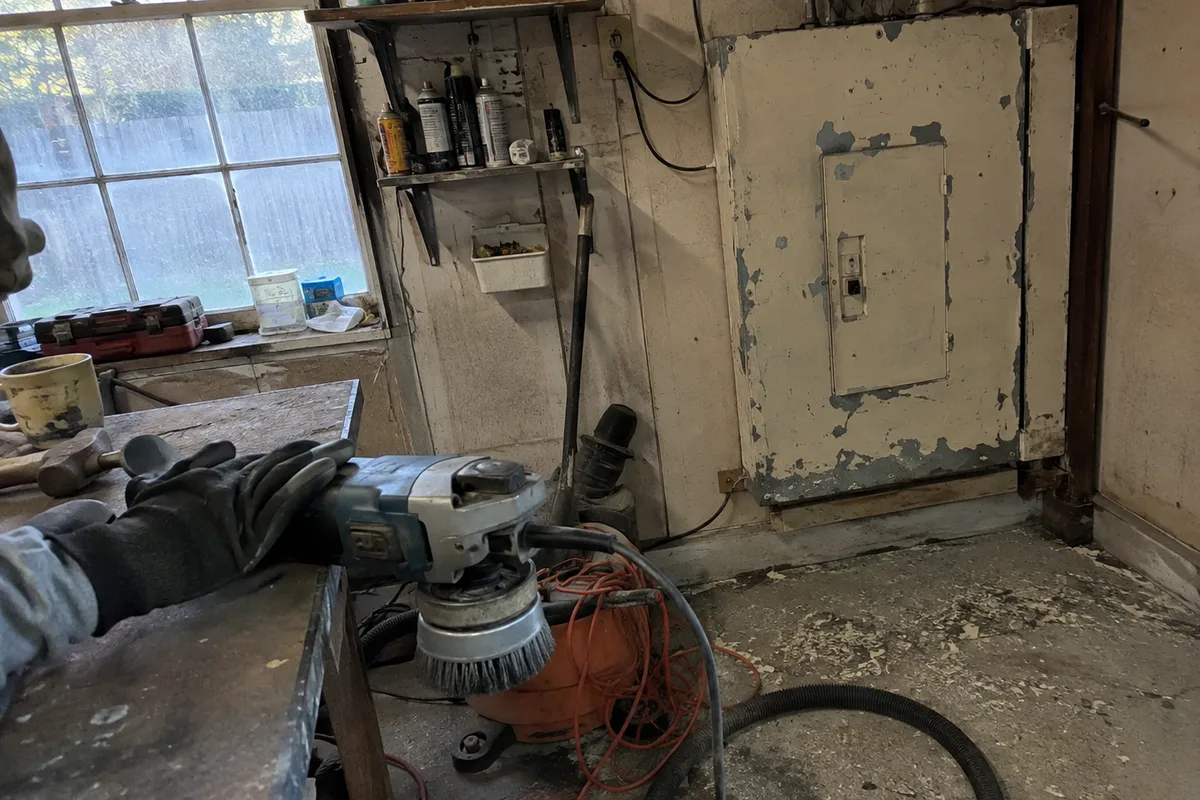
- Wire cup brush or grinder on a painted panel enclosure to get bare metal for a bond or a ground. Power tool cleaning without dust collection. Level 3.
- Torch cutting painted strut, painted rigid, or a painted steel column to make room for a run. Torch cutting. Level 3.
- Welding on painted steel, including tacking a bracket. Welding. Level 3.
- Cutting a channel or opening in painted plaster or painted wood siding with a grinder or a saw and no collection. Level 3 by the same language.
- Manual demolition to open up a wall for a rewire. Level 1.
- Scraping paint off a surface by hand to land a strap or read a stamp. Manual scraping. Level 1.
- Heat gun on painted trim or a painted box to loosen something. Level 1.
The pattern is unglamorous: this rule reaches ordinary rough-in and service work in old buildings, not just abatement contractors in moon suits.
Drilling is not on the list. That is not the same as being exempt.
Drilling does not appear by name in any of the three levels, and you will find people online who stop reading there. The rule anticipated that.
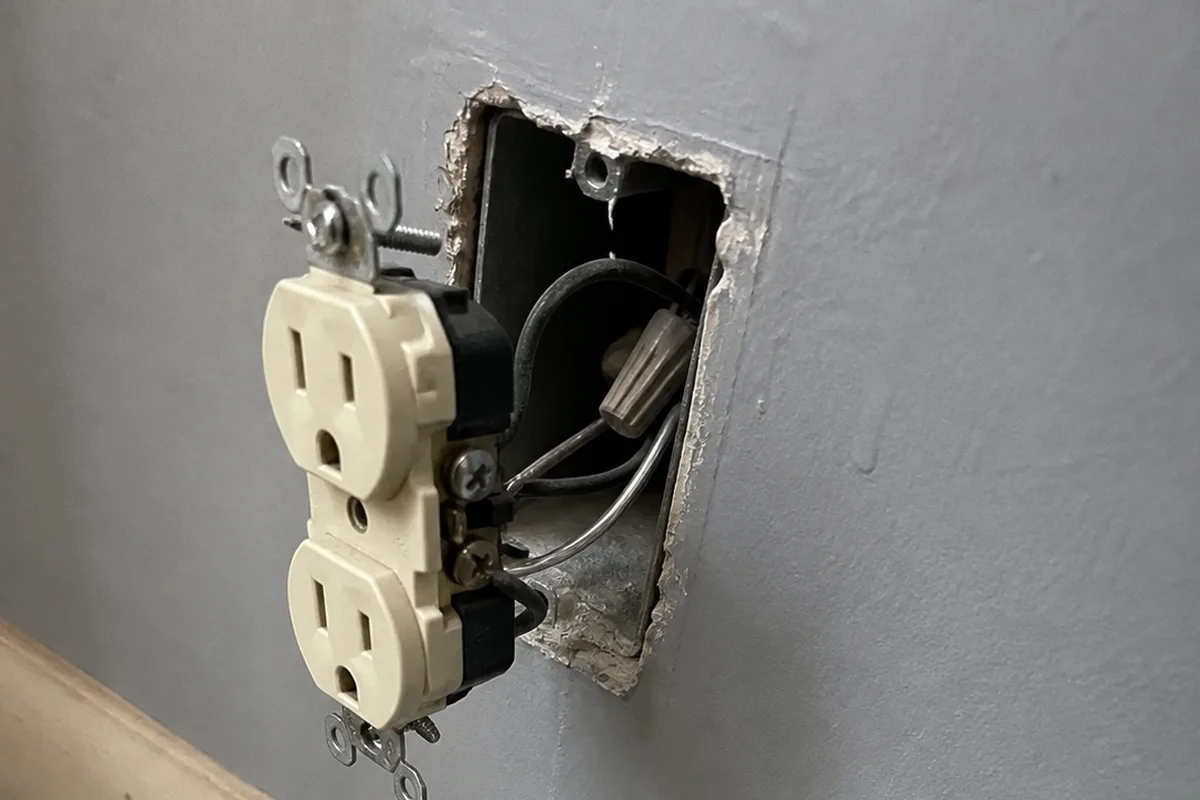
Subsection (d)(2)(B) covers a fourth category, a trigger task that is not listed. If the employer has any reason to believe an employee performing a task may be exposed above the PEL, that employee gets the same treatment as a listed trigger task until the assessment says otherwise. Boring a hole saw through painted plaster and lath for an old-work box, in a dusty crawlspace, with the debris falling on your face, is exactly the fact pattern that provision exists for.
The honest way to read section 1532.1 is that the lists tell you the presumed exposure multiple, not whether the standard applies to you at all. Subsection (a) is broad: it applies to all construction work where an employee may be occupationally exposed to lead.
The one number that gets you out
There is a persistent claim circulating in contractor and law-firm writeups that California now presumes every painted surface contains lead until you sample every layer. That is not what the regulation says. There is no blanket presumption sentence in section 1532.1.
What the rule actually does is put the burden on objective data. The standard’s objective-data provisions turn on whether a surface coating or material contains lead at concentrations equal to or exceeding 0.06 percent lead dry weight, which is 600 parts per million. Data showing the coating is below that figure is what lets you treat the work as outside the trigger-task machinery. Absent that data, you are inside it.
Six hundred parts per million is a low bar, and this is where a lot of electricians get a bad surprise. It is far below the threshold in EPA’s lead-based paint definition, the one the Renovation, Repair and Painting rule is built around. Paint can fail Cal/OSHA’s 600 ppm test and still not be “lead-based paint” for RRP purposes. Holding an RRP certification does not mean you have satisfied section 1532.1, and satisfying section 1532.1 does not cover your RRP obligations either. They are two separate rules with two separate thresholds, and you can be compliant with one while violating the other.
Practically, this means paint testing stops being an abatement-contractor expense and becomes a line item on your own bids for pre-1978 buildings. A few XRF readings or paint chip samples before you commit is cheaper than running Level 3 interim protection on a two-hour job because nobody knew.
What interim protection actually obligates you to do
This is the cost nobody prices. When a trigger task starts and the assessment is not done, subsection (d)(2)(E) requires the whole package, not just a mask:
- Respiratory protection appropriate to the presumed level, which at Level 3 is not a disposable dust mask
- Personal protective clothing and equipment
- Change areas, and shower facilities for Level 3 tasks
- Separate eating facilities and hand washing
- Regulated areas around the work
- Medical surveillance, which means blood lead testing, and training
A one-man shop cannot spin that up on the morning of the job. That is the real reason to decide the paint question before the truck rolls rather than at the wall.
How this changes your bids
- Add a testing line to old-house work. Pre-1978 construction, exterior painted metal, painted plaster, old painted panel enclosures. Price the sample, not the assumption.
- Buy the dust collection. The shroud and vacuum attachment for your grinder is the difference between Level 2 and Level 3 on the same cut, which is the difference between a respirator and a respirator plus showers plus a regulated area.
- Stop treating “it is only fifteen minutes” as an answer. The presumption in subsection (d)(2) attaches to the task, not to its duration. Duration matters to the 8-hour average you eventually measure, and you only get to use a measurement you actually took.
- Reprice torch and grinder work on painted steel. Commercial and industrial service work on old painted structures is where Level 3 lands hardest.
- Check your training records. Interim protection includes training. Records that reference the 30 and 50 microgram federal numbers are evidence that you were working to the wrong standard.
What to tell customers who call
Most of these calls do not arrive as lead questions. They arrive as “the panel in my 1948 garage is rusted,” or “we are opening up the plaster anyway, can you rewire while it is open,” or a general contractor asking you to hold a date on a remodel.
The plain version for a homeowner: their building is old enough that the paint has to be checked before certain kinds of cutting and grinding, it is a state worker-safety requirement rather than an upsell, and it either adds a small testing step to the schedule or it adds a significant containment step, and the test is what tells you which.
The reason this belongs in your intake and not in your site visit is that the two paths have very different prices and very different lead times. A first call that captures the building’s age, whether painted metal or painted plaster is involved, and whether anyone has already tested, tells you which bid you are writing before you burn a truck roll. A call that captures none of it produces a quote you have to walk back, which is the most expensive conversation in this trade.