Short answer: if you have been telling customers “the code now requires a surge protector when you upgrade your panel,” you are quoting a rule that has been in force in California since January 1, 2023. What actually changed this year is that surge protection stopped being a service-only requirement. The 2025 California Electrical Code took effect January 1, 2026, and it brings in two sections California did not have before: 215.18 for feeders and 225.42 for outside branch circuits and feeders. That pulls subpanels, detached garages, shops, ADUs, and every dwelling unit in an apartment building into scope. There is also a new minimum device rating that will fail you at inspection if you grab the cheapest SPD on the shelf.
What California is actually enforcing
The 2025 California Electrical Code was published July 1, 2025 and took effect January 1, 2026. It is based on NFPA 70, the 2023 National Electrical Code, with California amendments and additions. That is the edition your plan checker is working from.
Surge protection is not new to California. The 2022 CEC, which ran from January 1, 2023, already carried 230.67 requiring an SPD on services supplying dwelling units, including the replacement trigger. So the “swap the service, add a surge protector” requirement is almost three years old here. Plenty of sites are still writing it up as a 2026 change. It is not.
The 2023 NEC is where 215.18 and 225.42 first appear. Under the 2020 NEC, 230.67 was the only surge protection mandate of this kind. Now there are three, and they work in parallel across services, feeders, and outside feeders.
215.18, the one that matters most to you
The section is short. It reads, in substance:
(A) Surge-Protective Device. Where a feeder supplies any of the following, a surge-protective device shall be installed.
The listed occupancies are dwelling units, dormitory units, guest rooms and guest suites of hotels and motels, and areas of nursing homes and limited-care facilities used exclusively as patient sleeping rooms.
The rest of the section:
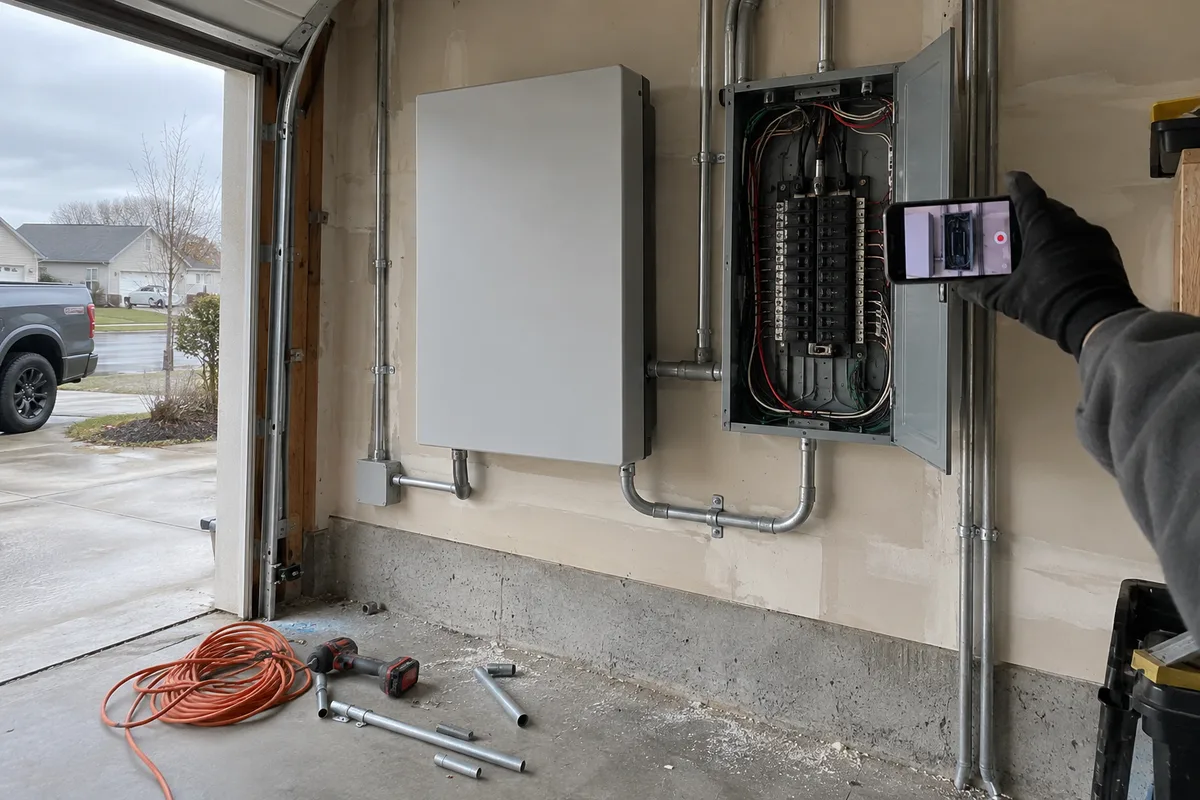
- (B) Location. The SPD shall be installed in or adjacent to distribution equipment, connected to the load side of the feeder, that contains branch-circuit overcurrent protective devices.
- (C) Type. The SPD shall be a Type 1 or Type 2 SPD.
- (D) Replacement. Where the distribution equipment supplied by the feeder is replaced, all of the requirements of this section shall apply.
- (E) Ratings. SPDs shall have a nominal discharge current rating of not less than 10 kA.
Read (D) twice. It is the same trap 230.67 set on service replacements, moved down to the subpanel. Replacing distribution equipment fed by a feeder pulls the SPD requirement into a job that used to be a straight swap.
The stated reasoning behind the feeder rule is about distance. An apartment building, hotel, or nursing home is typically fed by one service that then runs feeders a long way to individual unit panels. An SPD sitting at the service is a long way from the sensitive electronics it is supposed to protect. Putting the device at the unit panel puts it closer to the load.
225.42 catches the detached structure
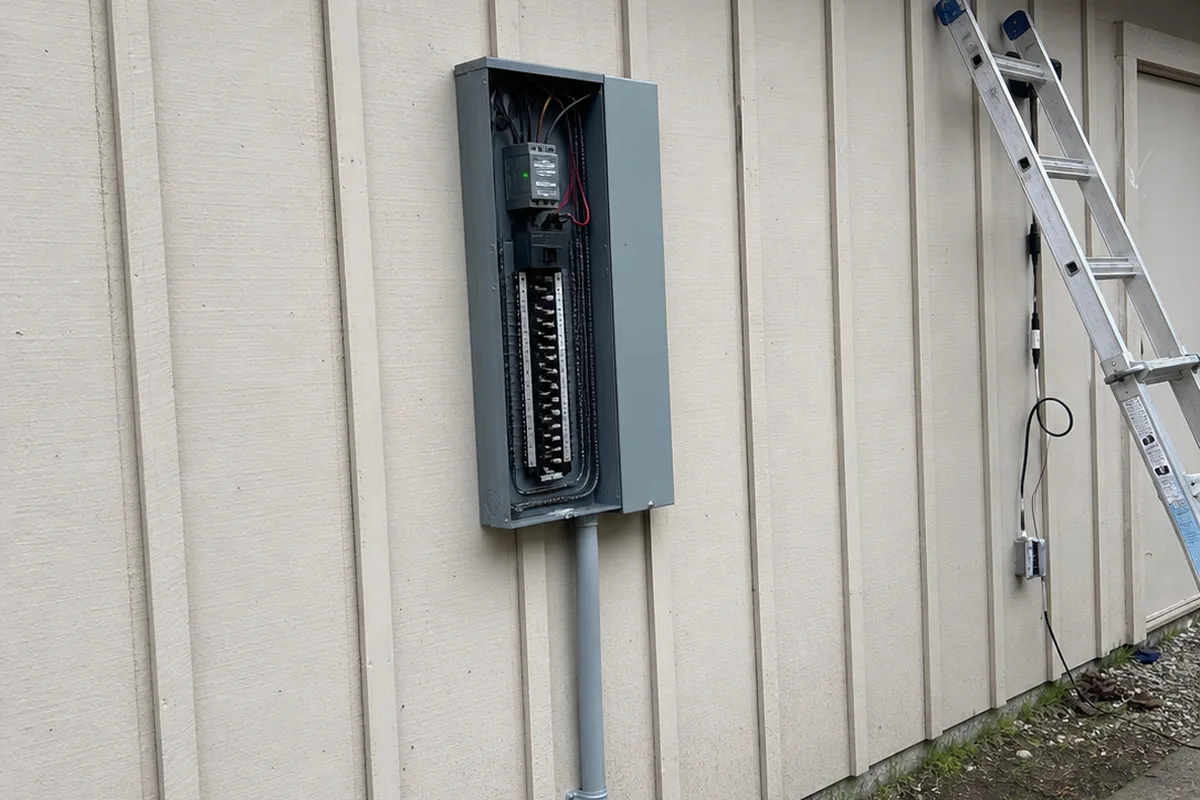
225.42 applies the same idea to outside branch circuits and feeders. That is the section that reaches across your property line work: the feeder from the house to a detached garage, a shop, a barn, or a separate ADU.
For California specifically, the ADU overlap is the one to think through. Read the text plainly. An ADU is a dwelling unit. If you are feeding it with a feeder from the main house, you have a feeder supplying a dwelling unit, and 215.18 and 225.42 both point at an SPD in the ADU panel. If the ADU gets its own separate service instead, you are back under 230.67. Either way there is a device in the job that was not there under the 2022 code.
Given how much ADU work is moving in California right now, this is not an edge case. It is going to show up on a lot of bids.
The interpretation question nobody has settled
Here is the honest gap, and you should know about it before an inspector raises it.
Take an ordinary single-family house. The service has an SPD under 230.67. Now you add a subpanel in the garage, fed by a feeder, serving that same dwelling unit. Does 215.18 require a second SPD at that subpanel?
The literal text says a feeder supplying a dwelling unit needs an SPD, and that feeder supplies a dwelling unit. The counterargument is that the intent was multifamily and similar occupancies, where the unit panel is far from the service, and that a house already protected at the service does not need a second device ten feet away.
Both readings have supporters in the field. What matters for your bid is that you do not get to pick the reading after the fact. Ask your AHJ how they are calling it before you price the job, and get the answer for the jurisdiction you are actually working in, because this is exactly the kind of question that gets answered differently one city over.
The 10 kA rating is the quiet failure
The nominal discharge current requirement in 215.18(E) is new with the 2023 NEC, and it is the detail most likely to cost you a return trip.
Nominal discharge current is the surge current level a device is rated to survive repeatedly without failing. The code now sets a floor of 10 kA. Plenty of inexpensive SPDs on the market are rated below that, and the number is not always on the front of the box. A device being listed and being compliant are two different questions, and so are compliant and available.
Before you standardize on a part, confirm three things with your distributor: that it is a Type 1 or Type 2 device, that the nominal discharge current rating is at least 10 kA, and that it physically fits the load centers you actually install. A breaker-style SPD that does not exist in the frame size your customer’s panel takes is not a solution.
A numbering trap worth knowing
If you are studying from the California significant-changes summaries that circulated through building departments and CALBO training this cycle, several of them print the feeder section as “215.8.”
The correct section is 215.18. In the NEC, 215.8 is the rule about identifying the conductor with the higher voltage to ground on a four-wire delta system, which has nothing to do with surge protection. If you cite 215.8 in a permit conversation you will confuse a plan checker who knows the book. Small thing, easy to get wrong, and it has been reprinted in more than one jurisdiction’s handout.
Where this shows up in your bids
- Subpanel replacements are the sleeper. 215.18(D) does to feeder-fed distribution equipment what 230.67(D) did to services. What you scoped as a panel swap may now include a device, and possibly a panel with room for it.
- Multifamily multiplies. On an apartment building, this is one SPD per unit panel, not one for the building. On a repipe-scale electrical retrofit that is a real material number, and it scales with unit count in a way a flat per-panel price will not survive.
- ADU feeders carry a device now. Build the SPD into your standard ADU electrical scope rather than discovering it at rough inspection.
- Detached garages and shops. 225.42 reaches the outbuilding feeder. The workshop subpanel job is no longer just wire, conduit, and a panel.
- Do not absorb it into last year’s flat price. A compliant SPD plus the labor to land it is a line item. If your panel-upgrade price has not moved since 2024, this is one of several reasons it should.
- Check panel compatibility before you promise a date. Not every load center takes a breaker-style SPD, and the external-mount alternative needs wall space and a short conductor run to work properly.
What to verify before you quote
Confirm the edition and the local amendments. California is on the 2025 CEC with a 2023 NEC base, but jurisdictions can amend and can be more restrictive than the state baseline. Los Angeles County, for one, adopts the electrical code by reference with its own amendment package.
Ask your plan checker two specific questions. First, how they are applying 215.18 to a subpanel inside a single-family dwelling that already has service-level surge protection. Second, whether they want the SPD inside the distribution equipment or will accept an adjacent external mount. Those two answers determine your material list and, on a panel with no spare spaces, whether the job grows.
What to tell the people who call you
Almost nobody calls you about surge protection. They call about a subpanel for a shop, a panel for the ADU they are permitting, or an apartment building that needs unit panels replaced. The code requirement is something you find, not something they report.
The plain version for a homeowner: the electrical code now requires a surge protection device on the panel, not just at the main service, and it applies when the panel is new or replaced. It protects the electronics in the building from voltage spikes coming in off the utility. It is a code requirement, not an add-on you invented.
The practical move is catching it at intake instead of at the truck. Whether the job is a service or a feeder, whether there is a detached structure or ADU involved, and how many unit panels are in play are three questions that decide whether you are quoting one device or twelve. Ask them on the phone and you are writing a scoped bid. Ask them on site and you are writing a change order. It is the same reason what you ask on a panel upgrade call decides whether that job is profitable, and the same discipline the 2026 load calculation changes are going to demand of your estimating.
This is not the only 2025/2026 code change worth tracking against last year’s flat pricing. The NEC 210.8(F) exception for outdoor HVAC equipment expired September 1, 2026, and like the feeder SPD rule, it changes what a routine-looking job actually requires.
These calls almost never open with “surge protective device.” They open with “we’re finishing an ADU” or “my tenant wants a subpanel in the garage for a shop.” The code question is usually the third or fourth sentence in, which is exactly why it gets missed on a voicemail and caught on a scripted intake instead.
Wirewoman’s intake for this kind of call already asks whether the job feeds a dwelling unit and whether it ties back to the main service or gets its own, the fork that decides whether 215.18, 225.42, or 230.67 governs. That answer is sitting in the job text before an estimator opens the file.