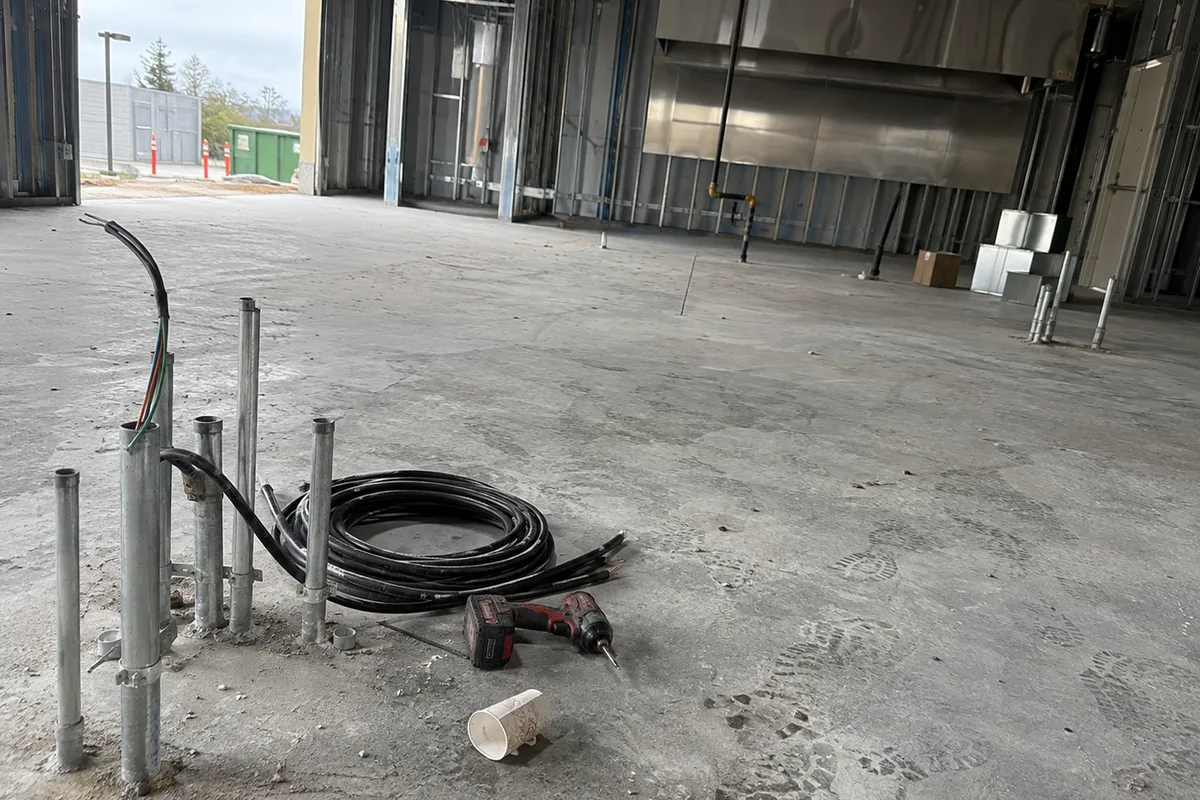
Short answer: since January 1, 2026, Section 120.6(k) of the California Energy Code requires electric readiness in newly constructed quick-service and institutional commercial kitchens. That means a dedicated branch circuit, wiring and an outlet accessible to cookline appliances, conductors rated at 50 amps minimum, and an electrical service panel with a minimum capacity of 800 connected amps, sized to accept an additional 208V or 240V 50-amp breaker.
If you are bidding restaurant, school, or cafeteria work off last cycle’s scope sheet, the service is the line item that moved.
The commercial clock kept running while the residential one stopped
The trade heard the other half of this story. AB 130 froze state and local building standards affecting residential units from October 1, 2025 through June 1, 2031, which is why there is no 2028 residential code cycle to plan around.
Nonresidential standards never stopped. They kept their normal three-year cadence, and the 2025 California Energy Code took effect on schedule. The Energy Commission’s own description is that the update “went into effect Jan. 1, 2026 for new buildings and major renovations.” If you run both residential and commercial work, you are now tracking two different clocks, and the commercial one is the one that just moved.
Section 120.6(k) is new in the 2025 edition, and it sits in the mandatory requirements subchapter for nonresidential buildings. Mandatory measures are the ones you cannot trade away through performance compliance. A better envelope or better lighting elsewhere in the building does not buy you out of this.
It names two kitchen types, not every restaurant
The section opens plainly: “Electric readiness for newly constructed commercial kitchens shall meet the following requirements.”
It reaches newly constructed quick-service and institutional commercial kitchens. Both are defined terms in Section 100.1(b) of the same code. A quick-service commercial kitchen is:
“A kitchen dedicated to an establishment primarily engaged in providing fast food, fast casual, or limited services. Food and drink may be consumed on the premises, taken out, or delivered to the customer’s location.”
An institutional commercial kitchen is:
“A kitchen dedicated to a foodservice establishment that provides meals at institutions including schools, colleges and universities, hospitals, correctional facilities, private cafeterias, nursing homes, and other buildings or structures in which care or supervision is provided to occupants.”
So the drive-through, the school cafeteria, and the private company cafeteria are all in scope. The section is narrower than a fast read suggests, though. “Kitchen, Full-Service Commercial” is a separate defined term in the same code, and 120.6(k) does not name it. A new sit-down restaurant kitchen is not swept into this section just for being a restaurant.
That is a statement about this section only, not a general exemption, and full-service kitchens still answer to the rest of the code. But the kitchen type on the plans is what decides whether 120.6(k) applies, and “restaurant” is not a fine enough answer.
Read the 800 amps precisely
The 800-amp minimum attaches to the electrical service panel serving the cookline appliances. Per the Energy Commission’s electric-ready compliance documentation, that is not automatically a statement about the whole building’s main service. Before you price anything, establish which panel on the drawings actually serves the cookline.
The same panel has to be sized to accept an additional 208V or 240V 50-amp breaker. That spare capacity is part of the requirement, not a courtesy you leave in case the owner electrifies later.
This is where your panel scope and your math need to agree with the plans, and the NEC 2026 load calculation changes are the other half of that arithmetic. It is also the second ready-circuit rule likely to show up on a commercial set, alongside Title 24’s EV-ready wiring requirements. They are not the same scope item. Price the conductors, outlet, breaker, and panel capacity each one actually calls for.
An 800-amp service also raises the utility question early rather than late. A large new service is exactly the kind of work that sits waiting on the utility, and California now requires PG&E and SCE to offer a way around some of those energization delays. Find out where the service stands before you commit to a schedule, then price the changed scope honestly instead of absorbing it.
Two exceptions, and one question you cannot answer yourself
Section 120.6(k) lists two exceptions: healthcare facilities, and all-electric commercial kitchens. The second one follows from the purpose of the rule. The section exists to prepare a kitchen for a future switch to electric cooking equipment, so a kitchen that is already all-electric has nothing left to get ready for.
The harder question is tenant improvements. The section’s own text is scoped to “newly constructed” kitchens. But Section 141.0, which governs additions, alterations, and repairs to existing nonresidential buildings, pulls Sections 120.0 through 120.6 onto altered components and newly installed equipment serving the alteration. Whether a buildout inside an existing shell picks up 120.6(k) turns on how your jurisdiction reads the scope of that alteration. Do not settle it from a quick read of the kitchen definition, and do not assume it cuts your way. Get the plan checker’s answer in writing before the bid goes out.
Ask it on the first call, not at the walkthrough
A commercial buildout call does not sound like a homeowner call. The GC or the project manager opens with a square footage, a landlord, and a date. Nobody opens with “quick-service kitchen.”
The two facts that decide whether this code section is in play, what kind of kitchen it is and whether the space is new construction or a tenant improvement in an existing shell, are almost never volunteered. They have to be asked while you still have the caller. By the time a walkthrough gets scheduled, the bid date is usually already set.
That is an intake problem more than a code problem. Wirewoman runs the electrical intake, books the job, and syncs it to your calendar, and the job summary reaches your phone by text about 30 seconds after the call ends. Adding the kitchen type and the new-construction-or-TI question to that intake costs nothing and puts both answers in your pocket before you ever open the drawings.
Before the next commercial bid, make sure you can answer:
- Is the kitchen quick-service, institutional, full-service, or something else?
- Is it new construction, or a tenant improvement in an existing shell?
- Does either listed exception apply, healthcare or already all-electric?
- Which panel serves the cookline appliances?
- Does that panel carry 800 connected amps and room for another 208V or 240V 50-amp breaker?
- Has the plan checker confirmed the alteration question in writing?
Last cycle’s kitchen scope does not transfer to a 2026 commercial bid. Price the panel and the service before the walkthrough, not after the number is already out the door.