NFPA 70E is not California law. It is a private organization’s consensus industry standard for electrical safety work practices.
The rules a Cal/OSHA inspector cites you under are in Title 8 of the California Code of Regulations, Low-Voltage Electrical Safety Orders, Article 3, “Work Procedures,” sections 2320.1 through 2320.11.
Following 70E is good practice. It is not the same thing as complying with California’s enforceable requirements, and the two documents do not use the same numbers. If you have built your safety program by buying a 70E handbook and stopping there, the document that decides what a Cal/OSHA citation costs you is one you may never have opened.
Article 3 is eleven sections long, free on dir.ca.gov, and most of them fit on one screen.
A 120/240V residential panel is inside the scope
Section 2305.2, “Scope and Application,” sets the boundary:
“These Low-Voltage Electrical Safety Orders apply to all electrical installations and electrical equipment operating or intended to operate on systems of 600 volts, nominal, or less and to all work performed directly on or in proximity to such electrical installations, equipment or systems in all places of employment in the State of California as defined in Labor Code Section 6303.”
Six hundred volts nominal or less covers essentially all residential and most light commercial electrical work. This is not a utility-only or industrial-only rule set, and it is not limited to work performed directly on the equipment. Work “in proximity to” it is inside the same scope.
Article 3 also does not displace the rest of Title 8. Other article-level rule sets catch electricians on particular jobs, which is how a routine service call in a crawlspace turns into a permit entry under the construction confined-space rules.
“Qualified person” is an employer designation, not your certification card
Section 2320.1 is two sentences, and the first one is the whole foundation: “Only qualified persons shall work on electrical equipment or systems.” The second extends it to work near energized overhead conductors, permitting only qualified persons “to perform any function in proximity to energized overhead conductors unless means to prevent accidental contact have been provided in accordance with Articles 3 and 4 of these orders.”
Section 2300 defines the term, and this is where contractors get it wrong. A “Qualified Person” is:
“A person, designated by the employer, who has received training in and has demonstrated skills and knowledge in the construction and operation of electric equipment and installations and the hazards involved.”
That is an employer designation backed by training and demonstrated skill. It is not the same thing as holding a DIR electrician certification card. You have to designate the person and be able to show the training and the demonstrated skills behind the designation. Your state certification and your shop’s designation are two separate records, and keeping your certification current does not by itself satisfy 2320.1.
Two more definitions matter because later sections lean on them. A “Qualified Electrical Worker” is a higher bar tied to high-voltage work, meaning a qualified person with “a minimum of two years of training and experience with high-voltage circuits and equipment” who has demonstrated familiarity by performance. An “Authorized Person” is “a qualified person delegated to perform specific duties under the conditions existing.” Sections 2320.4 and 2320.5 assign their duties to an authorized person specifically, not to whoever happens to be on the job.
Everything is energized until a test proves it is not
Section 2320.3 is one sentence:
“All electrical equipment and systems shall be treated as energized as required by Section 2320.2 until tested or otherwise proven to be de-energized.”
The burden runs the opposite direction from how people behave on a job. A breaker handle in the off position is not proof. A label on a panel schedule is not proof. Until the equipment has been tested or otherwise proven dead, every energized-work requirement in 2320.2 still applies to it.
Energized work takes all three conditions, decided before you start
Section 2320.2 opens by prohibiting the work: “Work shall not be performed on exposed energized parts of equipment or systems until the following conditions are met.” Three conditions follow, and they are cumulative rather than a menu.
The first is that “responsible supervision has determined that the work is to be performed while the equipment or systems are energized.” That is a decision made by supervision, before the work, not an improvisation by whoever is holding the meter.
The second is that “involved personnel have received instructions on the work techniques and hazards involved in working on energized equipment.” Job-specific instruction on this task, not a general safety orientation from onboarding.
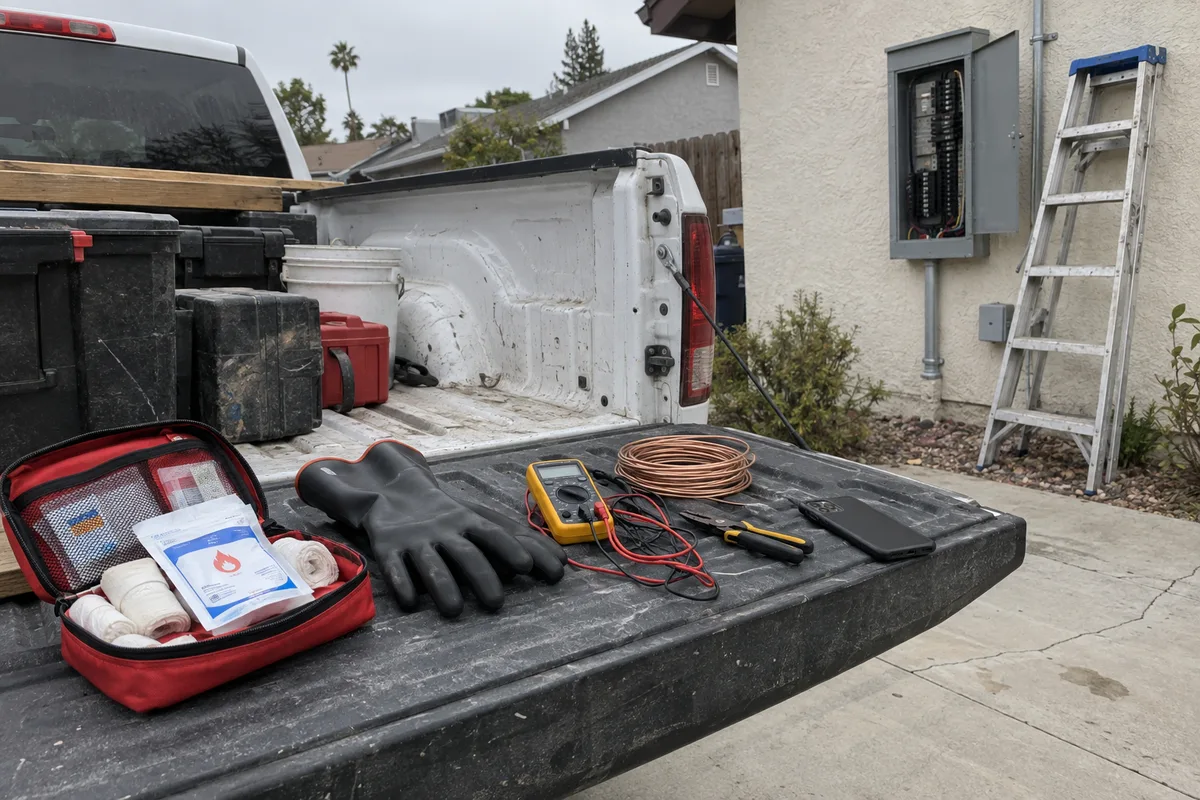
The third is that “suitable personal protective equipment and safeguards (i.e., approved insulated gloves or insulated tools) are provided and used.” Provided and used. Gloves in the truck do not satisfy the second half of that sentence.
Below 50 volts is a narrow provision, not a blanket pass
Section 2320.2 does relieve you of some protective measures on very low voltage, but read the whole sentence:
“The use of approved insulating gloves or insulated tools or other protective measures are not required when working on exposed parts of equipment or systems energized at less than 50 volts provided a conclusive determination has been made prior to the start of work by a qualified person that there will be no employee exposure to electrical shock, electrical burns, explosion or hazards due to electric arcs.”
Every clause carries weight. Under 50 volts. A conclusive determination. Made before work starts. Made by a qualified person. And covering four separate hazards: shock, burns, explosion, and arcs. “It is only low voltage” is not the determination this provision describes.
Stored energy is the step that gets skipped
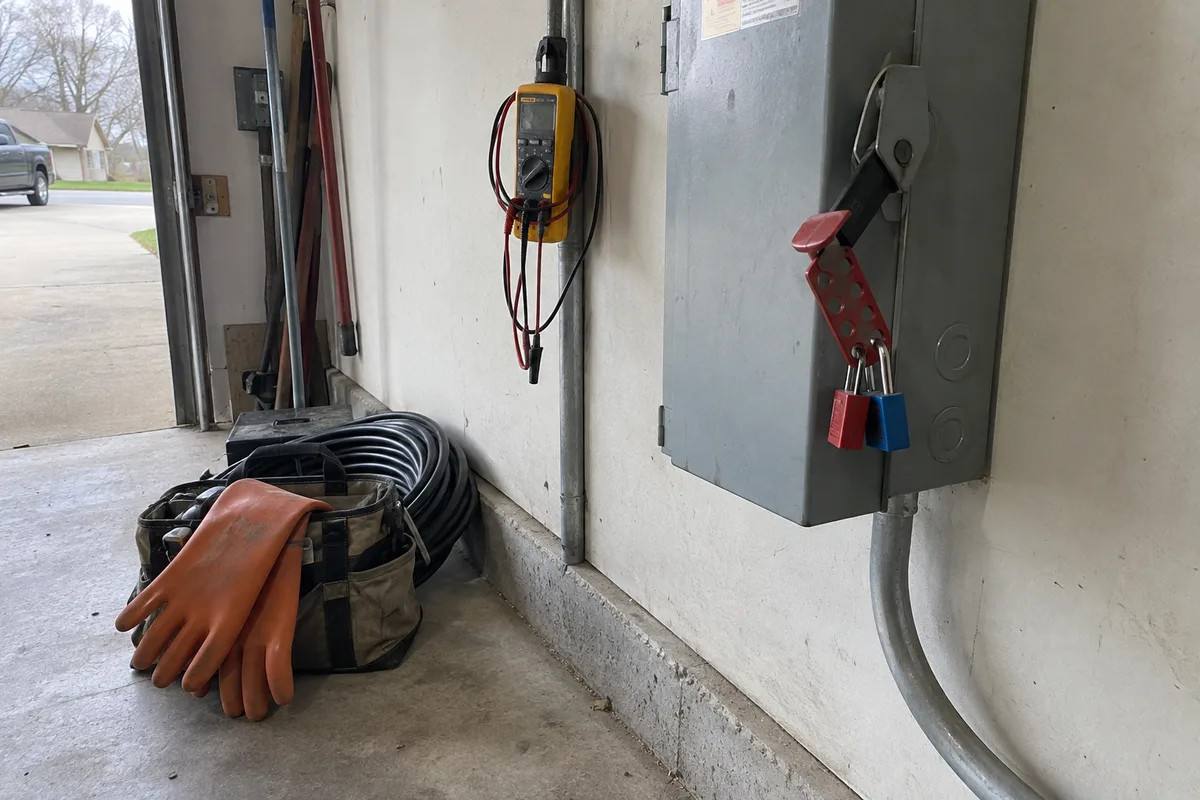
Section 2320.4 makes “an authorized person” responsible for four things before anyone works on de-energized equipment: notifying all involved personnel, locking the disconnecting means in the “open” position with lockable devices to prevent unexpected or inadvertent energizing, tagging the disconnecting means with suitable accident prevention tags, and “effectively blocking the operation or dissipating the energy of all stored energy devices which present a hazard.”
That fourth item is the one modern equipment turns into a real hazard. Capacitors, drives, and anything holding a charge after the disconnect opens are inside the rule, not outside it.
The section does contain an exception under which “locking is not required,” subject to specified tagging and personnel conditions. It is conditional, so confirm you actually meet it rather than treating the phrase as permission to skip a lock that is inconvenient. Note too that the tag itself is regulated: Article 3 carries a separate section, 2320.6, titled “Accident Prevention Tags.”
Write the lock-removal procedure before the day you need it
Section 2320.5 governs putting equipment back in service. An authorized person is responsible for determining “that all persons are clear from hazards which might result from the equipment or systems being energized,” and for removing locking devices and tags.
Then comes the line most shops have never read: “Locking devices and tags may be removed only by the employee who placed them.”
There is one way around it, and it has a precondition:
“When the employee has left the premises or is otherwise unavailable, other persons may be authorized by the employer to remove the locking devices and tags in accordance with a procedure determined by the employer.”
The procedure has to already exist. A shop with nothing written down has no lawful way to clear a lock left on a disconnect by an apprentice who went home at three. Writing that procedure costs an afternoon, and it is worth nothing if you start writing it on the day it is needed.
California’s arc flash clothing number is 2.0 cal/cm²
Section 2320.11, “Protection From Flames and Electric Arcs,” starts with assessment. Subsection (a)(1) requires the employer to assess the workplace in accordance with GISO Section 3203, the Injury and Illness Prevention Program requirement, to identify employees exposed to hazards from flames or electric arcs. Subsection (a)(2) then requires a reasonable estimate of the incident heat energy each exposed employee would face.
From there the rule sets clothing. The employer “shall select the apparel based on the hazard assessment in subsection (a)(2)” and ensure exposed employees are provided suitable apparel. A flame-resistant outer layer is required where any of the listed triggers applies, including where electric arcs could ignite flammable materials affecting clothing, where molten metal or arcs from faulted conductors could ignite clothing, or where the estimated incident heat energy exceeds 2.0 cal/cm². Where that estimate exceeds 2.0 cal/cm², employees exposed to electric arc hazards must wear protective clothing and equipment with an arc rating greater than or equal to the estimated heat energy, covering the whole body except hands, feet, and head, with specified exceptions. The incident energy estimate requirement carries an implementation date of October 1, 2018 under subsection (b)(3).
2.0 cal/cm² is California’s enforceable threshold, written into California’s own regulation. Consensus standards set their own thresholds independently, on their own schedules. The number you are measured against here is the one in 2320.11.
The same section also bans apparel that “could melt onto the employee’s skin or that could ignite and continue to burn.” That is a plain-language description of an ordinary synthetic work shirt or a poly-blend hoodie, and it applies to what the crew is wearing regardless of what is folded in the truck.
Keep this separate from the labeling question. The NEC 110.16 arc flash marking rules govern the sticker on the equipment. Section 2320.11 governs what the person standing in front of it has on.
Backfeed protection reaches the portable generator too
Section 2320.9, “Backfeeding or Interconnection,” is broader than most people assume:
“No electrical power source, permanent or temporary, shall be connected to a premises wiring system, or parts of such a system, unless positive means are used to prevent the transmission of electricity beyond the premises wiring system, or beyond any intentionally segregated parts of such system.”
The exception is narrow: “when an interconnection has been authorized by the servicing utility.”
“Permanent or temporary” and “positive means” are the operative words. That reaches a portable generator dragged out on a storm call, a permanently installed standby generator, and solar and battery backup alike. It also makes utility interconnection authorization a safety compliance matter, not just a paperwork step for the utility’s benefit.
The whole article, so you can read the rest
Article 3 runs: 2320.1 General, 2320.2 Energized Equipment or Systems, 2320.3 Tests, 2320.4 De-Energized Equipment or Systems, 2320.5 Energizing (or Re-Energizing) Equipment or Systems, 2320.6 Accident Prevention Tags, 2320.7 Safety Precautions, 2320.8 Fall Protection, 2320.9 Backfeeding or Interconnection, 2320.10 Medical Services and First Aid, and 2320.11 Protection From Flames and Electric Arcs.
The energized-work decision belongs at the shop, not in the driveway
Put 2320.2 and 2320.3 next to each other and a scheduling problem appears. Supervision has to decide before the work whether it will be done energized, and everything counts as energized until somebody tests it. Both of those go better when you already know what you are driving to.
On every panel or power call, Wirewoman asks the caller, “Is there smoke, sparking, or a burning smell?” She answers in 2 seconds, day or night, greets the caller as your shop, and runs the electrical intake from there. Her triage sorts a life-threatening fault from a routine job across three levels: sparking, smoke, a burning smell, or full power loss ring your cell right away, and routine work books into your schedule instead. Within 30 seconds of hang-up you get the job as a text, including the problem in the caller’s own words, and every call lands on a dashboard.
The caller’s own words are the part that matters for this decision. “Breaker won’t reset” and “there’s a burned smell at the panel” are two different trips, and knowing which one you have before the truck moves is what lets supervision make the 2320.2 call with the PPE already chosen. That is the same reason the questions you ask on every electrical call are worth standardizing.
She does not make the safety determination for you and she does not give legal advice. She gets the description on record and in your pocket while there is still time to act on it.
Four things to fix this week
Designate your qualified persons in writing, and keep the record that shows the training and demonstrated skills behind each designation.
Write the lock-removal procedure now, before someone leaves a lock on a disconnect and goes home. Get the incident energy estimate done where 2320.11 requires it. Then go through the clothing your crew actually wears and pull anything that could melt onto skin or keep burning.
After that, read Article 3 once, end to end, on dir.ca.gov. Reading only NFPA 70E and assuming you have read California’s rule is the mistake this whole article is about.