TL;DR: A sounding smoke or CO alarm is a get-out-and-call-911 call, not an electrical service booking. A chirp is usually a scheduled replacement or battery call, while a sale, new tenancy, or permit final requires you to identify the legal reason, the person who authorizes the work, and the deadline.
The first question sorts the call
Ask one question first: Is the alarm sounding continuously right now, or is it chirping?
A sounding smoke or CO alarm is an active safety event. A chirp is usually a battery or end-of-life issue. A compliance call comes from a sale, a new tenancy, or an inspection deadline.
That first answer changes the script, the urgency, the person who pays, and whether you should book a technician at all. The distinction belongs in your electrical emergency intake process, not in the technician’s driveway.
The intake should also identify the alarm type. Ask whether it is a smoke alarm, a CO alarm, or a combination unit. Ask how many alarms are in the house and whether they all sound together. Alarms that sound together are interconnected, which usually means they are hardwired.
A sounding alarm is a 911 call, not a booking
Kidde instructs people to move to fresh air immediately when a CO alarm sounds, either outside or near an open door or window. They should dial 911 or the local fire department, account for everyone, and not re-enter until emergency services give the all clear.
Your phone script should tell a caller with a sounding CO alarm, or a sounding smoke alarm, to get out and call 911. Do not keep that caller on the line collecting job details. Do not turn an active alarm into an after-hours service appointment.
The fire department clears the house first. Booking an electrician comes later.
Your shop’s own escalation rules decide what the caller is told and whether the call goes to the on-call number. That rule should be written into the after-hours call policy every electrical shop needs.
A chirping alarm calls for the date on the back
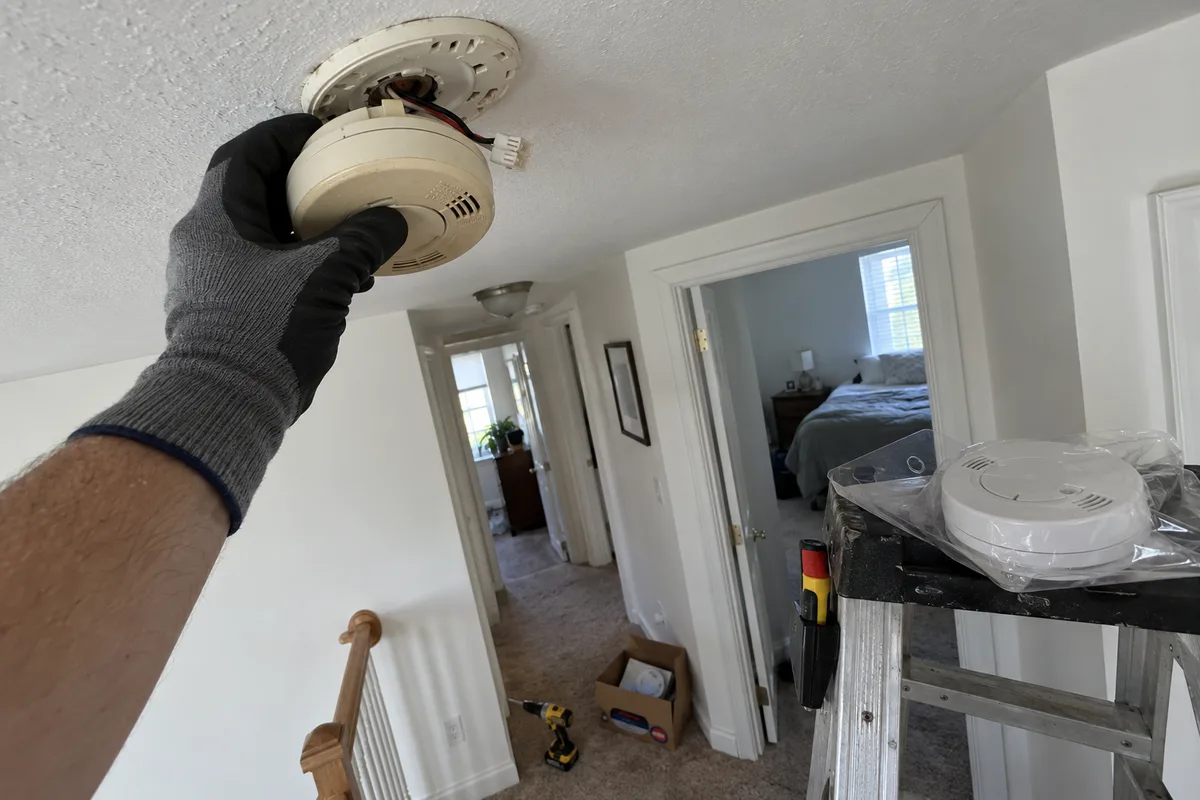
For a chirping alarm, ask the caller to look at the back of the device, taking it down from the ceiling plate only if it is safe to do so. That instruction applies to a chirping alarm. Never ask a caller to take down an alarm that is sounding.
Since January 1, 2015, Health and Safety Code 13114(b)(3) has required a smoke alarm to display its date of manufacture, provide a place to write the installation date, and have a hush feature. Ask the caller to read the manufacture date.
If the alarm is more than 10 years old, plan to replace the alarm. U.S. Fire Administration guidance says, “Replace the entire smoke alarm every 10 years.” It also says to test the alarm monthly. For hardwired alarms, replace the backup battery at least once every year. Interconnected smoke alarms are recommended so that when one sounds, they all sound.
A battery-only smoke alarm approved and listed by the State Fire Marshal must contain a nonreplaceable, nonremovable battery capable of powering it for at least 10 years under Health and Safety Code 13114(b)(2)(A), effective July 1, 2014. On that sealed 10-year device, an end-of-life chirp means replacing the alarm, not swapping a battery.
If the manufacture date shows an old device, the technician should arrive with replacement alarms instead of a pack of batteries. The count of alarms and whether they are interconnected tells you how many devices to bring and what kind of job you are pricing.
That turns “it keeps beeping” into a replacement job on the first visit. Use the same intake discipline described in the questions to ask on every electrical call.
Sale and tenancy calls have a legal payer
A home sale is not the same call as a nuisance chirp. Health and Safety Code 13113.8(a) requires every single-family dwelling, including a one or two-unit dwelling, that is sold to have an operable smoke alarm. Under Health and Safety Code 13113.8(b), the seller, called the transferor, must give the buyer a written statement that the seller is in compliance.
Ask whether the call is tied to a sale. Ask who owns the property and who authorizes the work. A seller’s compliance statement may make the deadline clear. The related home inspection report call may also identify the work that needs to be completed.
Rental calls have a different authorization path. Under Health and Safety Code 13113.7(d)(2), the owner of a rented apartment complex or other rented multiple-dwelling complex, and since January 1, 2014 the owner of a rented single-family dwelling, is responsible for testing and maintaining smoke alarms.
When a new tenancy is created, Health and Safety Code 13113.7(d)(2)(B) requires the owner to make sure the smoke alarms are operable. The tenant must tell the owner or manager about an inoperable alarm.
The owner or owner’s agent may enter to install, repair, test, and maintain the alarms under Health and Safety Code 13113.7(d)(2)(A). Except in emergencies, the owner must give reasonable written notice and enter during normal business hours. Twenty-four hours is presumed reasonable notice.
Health and Safety Code 17926.1 places responsibility for maintaining CO devices on the owner who rents a dwelling unit. The CO device must be operable when the tenant takes possession, and the tenant must notify the owner about an inoperable device.
So when a tenant calls about a chirping alarm, the tenant is usually reporting a condition the landlord is legally responsible for. The landlord or property manager is usually the person who authorizes and pays. Run the ownership check from when a renter calls and get the owner or manager involved before dispatch.
Health and Safety Code 17926(a) requires an owner to install a State Fire Marshal approved and listed CO device in each existing dwelling unit with a fossil fuel burning heater or appliance, a fireplace, or an attached garage. For existing single-family homes, the deadline was July 1, 2011. An all-electric home with no fireplace and no attached garage may not need one under this section. A gas furnace, gas water heater, fireplace, or attached garage changes that question.
Your permit final can be held for alarms
Your own permitted work can create the alarm call.
For a dwelling unit with a building permit issued on or after January 1, 2014 for alterations, repairs, or additions exceeding $1,000, Health and Safety Code 13113.7(a)(2) says the permit issuer shall not sign off on completion until the permittee demonstrates that all required smoke alarms are approved and listed by the State Fire Marshal.
Health and Safety Code 17926.2(b) also makes a permit for alterations, repairs, or additions costing more than $1,000 the trigger for bringing existing CO devices up to current building standards.
That can include the panel upgrade or remodel circuit job you already sold. Ask about the existing smoke and CO alarms when you scope the work. Put the alarm work in the quote before the inspection. Do not discover it as a surprise change at final.
Danville shows how a jurisdiction can handle this. Its building department form, “Self Certification Smoke & Carbon Monoxide Alarm Declaration,” revised December 2025, states that smoke and CO alarms are required “anytime a permit is obtained” for a single-family or multifamily dwelling. It cites R314 and R315 of the 2025 California Residential Code. The owner signs the form and gives it to the inspector.
The form lists smoke alarms in each sleeping room, outside each separate sleeping area near the bedrooms, and on each additional story, including basements and habitable attics. It also lists placement at least 3 feet horizontally from a bathroom door with a tub or shower unless that would prevent required placement.
For CO alarms, it lists placement outside each separate sleeping area near the bedrooms, on every occupiable level including basements, and inside a bedroom when a fuel-burning appliance is in that bedroom or its attached bathroom. Combination smoke and CO alarms are permitted in lieu of CO alarms under R315.4.
Check your own jurisdiction’s form. Local handling varies.
Violations of Health and Safety Code 13113.7 and Health and Safety Code 17926 are infractions with a maximum fine of $200 per offense. Under Health and Safety Code 17926(c)(2), a property owner gets a 30-day notice to correct first.
The job summary should carry the decision-making facts
Wirewoman answers 24/7, books to the calendar, sends the job summary by SMS within 30 seconds, logs every call to a dashboard, and routes urgent calls by the shop’s own escalation rules.
Applied here, a chirping alarm at 2 a.m. gets booked into a weekday slot instead of waking the on-call technician. A call that the shop’s rules mark urgent goes to the on-call number.
The SMS summary should carry the alarm type, alarm count, manufacture dates the caller read off, whether the alarms are interconnected, and the reason for the call: sale, new tenant, permit final, or nuisance chirp. It should also identify who owns the property.
Change the script now:
- Ask whether the alarm is sounding or chirping.
- If it is sounding, tell the caller to get out and call 911. Do not collect booking details first.
- For a chirp, ask for the manufacture date, alarm count, alarm type, and whether the units sound together.
- Ask whether the call concerns a sale, new tenancy, permit final, or nuisance chirp.
- Ask who owns the property and who authorizes payment.
- For your own permit jobs over $1,000, ask about existing alarms before you send the quote.
- Check your jurisdiction’s alarm form before promising what the final inspection will require.