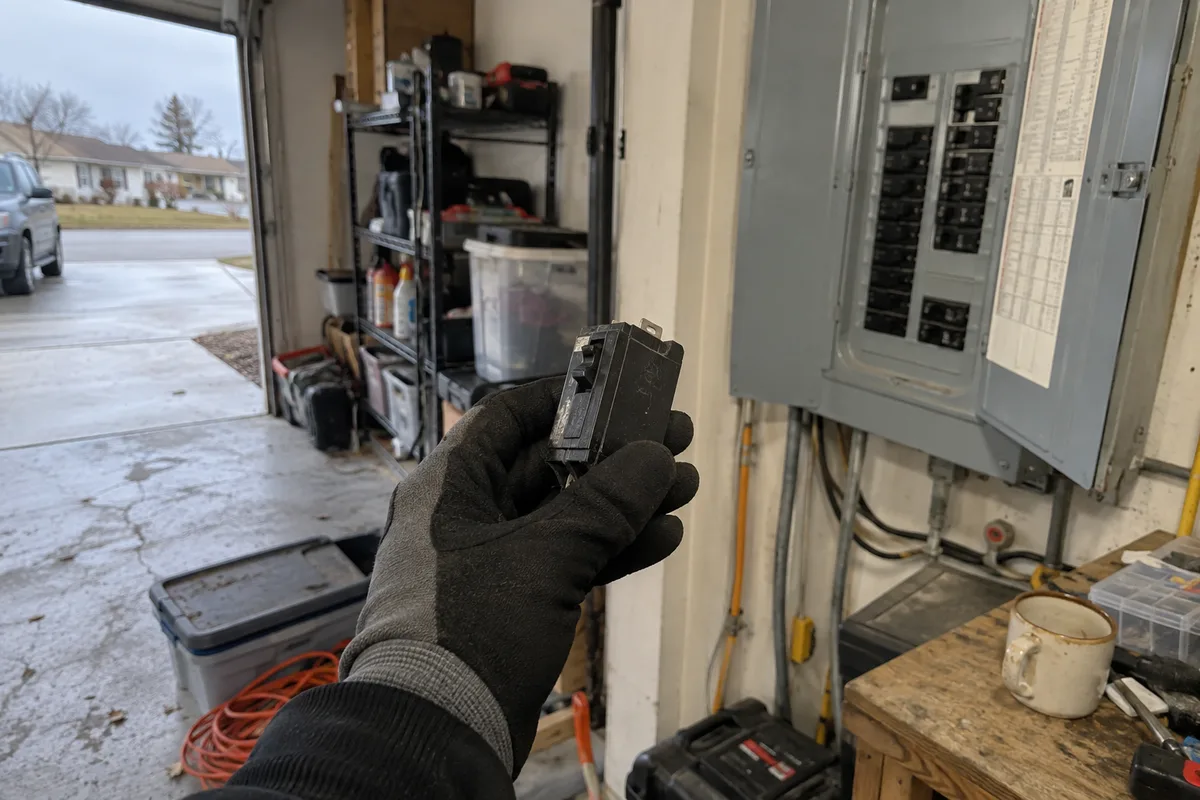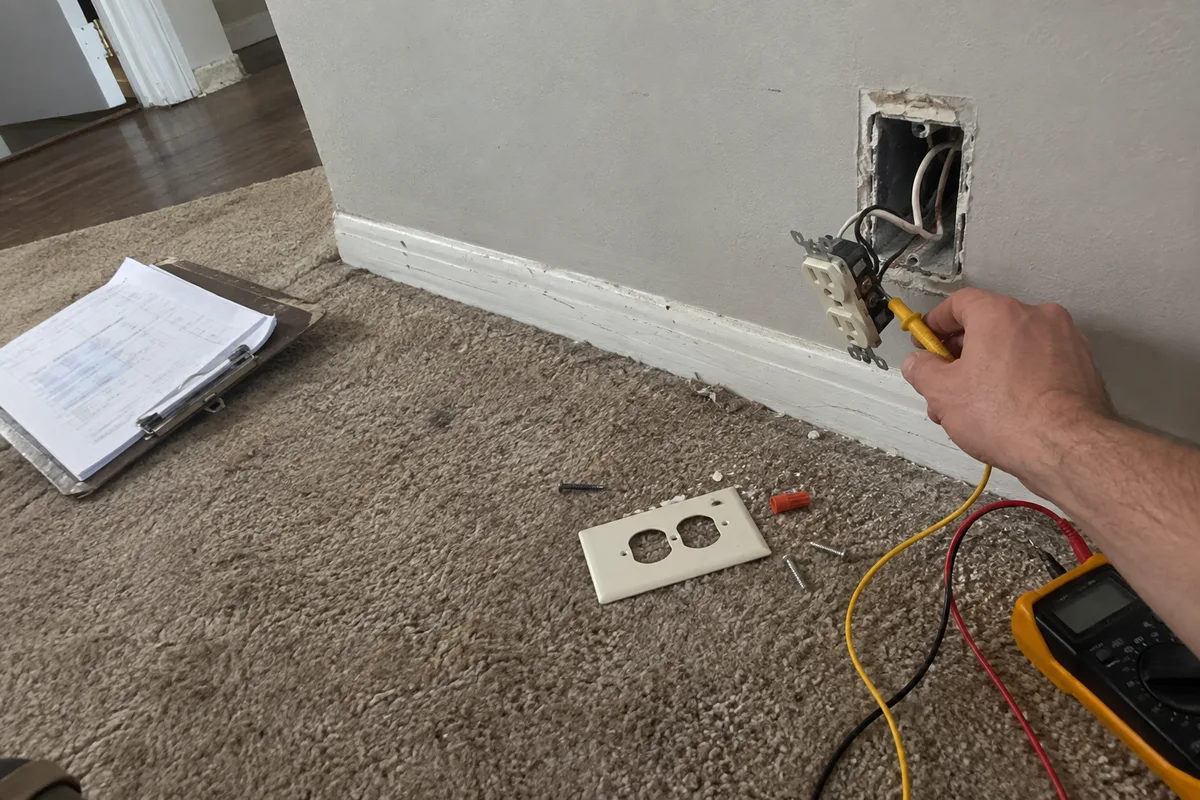
Free does not book better. ServiceTitan found that the booking rate for a free diagnostic is actually lower than the booking rate when the diagnostic costs between 1 cent and $49.99, and that result holds across all company sizes.
The fee is not what loses the job.
The booking data favors charging something
ServiceTitan is a field service software vendor, and it sells software to the same contractors its analysis covers. Read the numbers as vendor-published data, not a neutral study. The finding is still direct: booking rates “remain steady until they reach $89.99.” They do not start falling off until the fee passes roughly $90. ServiceTitan’s own conclusion is that “for most companies that fee is about $89.”
Electrical residential work has no single standard price. Companies are “about equally likely to charge homeowners either no fee, about $90 or about $150.” The market is split three ways, which means there is no industry norm you can point at to justify your choice. You have to make it yourself.
HVAC residential work clusters at either $0 or about $89. Commercial companies across the trades are far more likely than residential companies to charge more than $100.
So a free estimate is not the safe default it feels like. Moving from free to one cent does not cost you bookings in this data. It correlates with more of them. What the caller needs is not a zero, it is a clear statement of what the charge covers and why the trip is worth it, which is the same skill behind handling price-shopper calls.
California gives you a service and repair contract lane
Business and Professions Code section 7159.10 creates a lighter contract form called a “service and repair contract,” as an alternative to a full home improvement contract. You can use that form only if all four of these conditions are met.
First, “The contract amount is seven hundred fifty dollars ($750) or less.”
Second, “The prospective buyer initiated contact with the contractor to request the work.”
Third, “The contractor does not sell the buyer goods or services beyond those reasonably necessary to take care of the particular problem that caused the buyer to contact the contractor.”
Fourth, “No payment is due, or accepted by the contractor, until the work is completed.”
All four matter. This is not a menu where you satisfy three and ignore one.
The customer has to call you. Work you solicited is not a service and repair contract under this provision. A door-to-door pitch or an outbound sales call does not establish the buyer-initiated contact that condition B requires.
The work also has to stay tied to the problem that caused the call. A customer calls about a dead outlet, you diagnose the dead outlet. Turning that same call into a panel upgrade sale can break condition C if the added service goes beyond what is reasonably necessary to take care of the original problem.
The statute defines when the work is finished, too. All the conditions that caused the buyer to contact you must be fully corrected, and building department approval obtained where that applies.
Condition D controls when you collect. You cannot take the estimate fee or the diagnostic fee up front on this contract. No payment is due or accepted until the work is complete. The fee is real and chargeable. You collect it at the end, not at the door.
One service charge means one charge
This is the part that trips contractors up.
If you charge a service charge, the contract must include the heading “Amount of Service Charge,” followed by the amount. The contract must also carry this statement: “You may be charged only one service charge, including any trip charge or inspection fee.”
Section 7159.10 says a service and repair contractor shall charge only one service charge, and that single charge includes charges such as a service charge, a trip charge, or an inspection fee.
A trip charge plus an inspection fee plus a diagnostic fee is not three line items on this contract. It is one service charge, and stacking them violates the rule.
Pick one number and let it cover the trip, the inspection, and the diagnosis. That number still has to survive contact with your own costs, because one charge now has to carry the drive, the meter time, and the write-up that used to sit on three separate lines. Building it from your real numbers instead of a competitor’s sticker is the whole exercise in pricing electrical jobs without underbidding yourself, and what electricians charge hourly, by the day, and per call-out is the related question of where the rest of your pricing lands.
Breaking one condition gives the customer three business days
The service and repair contract notice tells the buyer they may cancel within three business days of signing “for normal service and repairs.” It also tells the buyer they may cancel if any of four things happened:
- “You may cancel the contract if the price, including all labor and materials, is more than seven hundred fifty dollars ($750).”
- “You may cancel the contract if you did not initiate the contact with the contractor to request the work.”
- “You may cancel the contract if the contractor sold you goods or services beyond those reasonably necessary to take care of the particular problem that caused you to contact the contractor.”
- “You may cancel the contract if the payment was due or the contractor accepted any money before the work was complete.”
Those four cancellation grounds map one to one onto the four conditions above. Each condition you break is a cancellation right you handed the customer, in writing, on your own form.
B&P 7159.11 adds that a violation of any provision of 7159.10 by a licensee, a person subject to be licensed, or their agent or salesperson is cause for discipline.
And the cancellation can now reach you by email. AB 1327 took effect January 1, 2026, making email a valid channel for a Notice of Cancellation, with the address required on the first page of the contract. If you are revising your service and repair form anyway, AB 1327 and the email a cancellation can now arrive by is the other change that belongs in the same edit.
Above $750, the lighter lane closes
The service and repair contract is available only at $750 or less.
The full home improvement contract starts lower than that. B&P 7159(b) defines a “home improvement contract” as an agreement, “whether oral or written, or contained in one or more documents,” between a contractor and an owner or tenant for a home improvement, where the aggregate contract price “exceeds five hundred dollars ($500).”
Read that definition twice. Oral or written. One or more documents. A verbal number over $500 given on a driveway is already a home improvement contract. It does not become one later, when somebody signs something.
So between $500 and $750, both forms are in play, and the service and repair contract is the lighter path if all four conditions hold. Above $750 that option is gone and you are on a full home improvement contract.
B&P 7159(a)(1) identifies the projects for which a home improvement contract is required, outlines the contract requirements, and lists the items that must be included or attached. Failure to provide the specified information, notices, and disclosures, or to otherwise comply with the section, is cause for discipline under B&P 7159(a)(5)(A). If the required Notice of Cancellation is not included in or attached to the contract, B&P 7159(a)(6) says the buyer may file a complaint with the Contractors State License Board.
The money rules change too. Under B&P 7159.5(a), the downpayment cannot exceed $1,000 or 10 percent of the contract amount, whichever is less, and you cannot accept payment exceeding the value of the work performed. B&P 7159.5(b) makes violations of specified paragraphs misdemeanors, with fines of not less than $100 and not more than $5,000, and up to one year in county jail.
“Free estimates” has to mean free everywhere
The problem with a paid diagnostic is not the fee. It is advertising one thing and charging another.
B&P 7161 makes certain home improvement conduct both a misdemeanor and cause for discipline. That includes using false, misleading, or deceptive advertising as an inducement to enter into a contract for a work of improvement where it may mislead or injure the public. It also includes publishing advertisements with false, deceptive, or misleading assertions, or advertising work without the intent to perform at the advertised price. The section became operative July 1, 2021.
If you move to a paid diagnostic, “free estimates” has to come off everything at once: the website, the truck lettering, the directory listings, and the greeting a caller hears. The lettering is the one people remember to change. The phone greeting is the one that sits there for another two years promising something your contract no longer does.
A flat amount fits this call better than an open meter
A service and repair contract must be in writing and state the agreed contract amount, and that amount “shall include the entire cost including profit, labor, and materials, but excluding finance charges.”
That is a stated total, not an open meter. The statute effectively settles the hourly-versus-flat question for this category of call.
If you bill an open hourly rate on a small repair and the total drifts past $750, you have left the service and repair lane in the middle of the job, and the customer now holds a written cancellation right on exactly that ground. Set the total before the work proceeds. If the job is clearly going to exceed the ceiling, write it on the contract that fits it instead of stretching this one.
The phone call is where the first condition is decided
Condition B turns on who initiated contact. An inbound call is your record that the buyer came to you. An inbound call nobody answered is not a record of anything.
That makes intake part of the contract, not just scheduling. Whether the visit is a diagnostic or a quotable job is usually settled by what the caller says before anyone starts the truck. A caller who already pressed the GFCI reset and watched it hold is describing different work than a caller with a dead circuit and no idea why, and those two trips should not carry the same number.
That distinction is exactly what Wirewoman’s intake is built to pull out. She answers in 2 seconds, day or night, greets the caller as your shop, and asks the electrical questions: panel or power, breaker behavior, outlet or GFCI, lighting, EV charger, and the caller’s preferred time. The published script is specific. For panel or power, “Is there smoke, sparking, or a burning smell?” For a breaker, “Did it trip? Does it reset or trip again?” For an outlet, “Which room? Did you try the reset button?”
Routine work gets booked into your schedule. Sparking, smoke, a burning smell, or full power loss rings your cell right away. Within 30 seconds of hang-up you get the whole job as a text: name, address, the problem in the caller’s own words, how urgent it is, and the time she booked. That text goes out on every answered call, booked or escalated, and every call lands on a dashboard, which is where the inbound record for condition B actually lives. The questions themselves are the ones worth asking anyway, the same ground covered in the questions worth asking on every electrical call.
She does not set your fee or give you legal advice. She answers, gets the caller on record, and hands you the detail that tells a diagnostic from a quotable job before you spend a truck roll finding out.
Pick the number, then fix the paperwork and the words
The data does not tell you to give estimates away. Free did not book better than a small charge, and ServiceTitan puts the workable figure for most companies at about $89.
California law sets the boundaries around whatever you pick. On a service and repair contract: confirm the customer called you, keep the work tied to the problem that caused the call, state one service charge, take no money until the work is complete, and keep the total at $750 or less. Put the “Amount of Service Charge” heading and the required one-charge sentence on the form. Above $750, use the full home improvement contract.
The decision was never really whether to charge. It is choosing one number, knowing what it covers, saying it out loud before the appointment, collecting it at the right moment, and writing it on the contract that matches the total.