TL;DR: SB 1365 takes effect January 1, 2027, but California’s 10 percent cap and 180-day limit on disaster repair work are not new. The change is that the exception for higher costs becomes an affirmative defense that you must prove with your pre-emergency rates, markup, and cost records.
SB 1365 changes the defense, not the 10 percent cap
Governor Gavin Newsom approved SB 1365 by Senator Benjamin Allen on September 30, 2026. It is Chapter 1028, Statutes of 2026. There is no urgency clause, so it takes effect January 1, 2027.
The bill is mostly about rental housing. It expands the definition of housing to cover rental housing regardless of the lease term. For electrical contractors, the important change is in Penal Code section 396, California’s price gouging statute.
The Legislative Counsel’s Digest says existing law “exempts certain price increases from these provisions.” SB 1365 instead frames those exemptions as affirmative defenses.
That wording matters. The cap itself is old law. The proof structure changes on January 1.
Repair work remains capped at 10 percent for 180 days
The rule applies after a state of emergency declared by the President or Governor. It also applies after a local emergency declared by an official, board, or governing body with authority in a county, city, or city and county.
A local declaration counts on its own. The 180 days run from the proclamation or declaration.
Current Penal Code section 396(c) states:
“(c) Upon the proclamation of a state of emergency declared by the President of the United States or the Governor, or upon the declaration of a local emergency by an official, board, or other governing body vested with authority to make that declaration in any county, city, or city and county, and for a period of 180 days following that proclamation or declaration, it is unlawful for a contractor to sell or offer to sell any repair or reconstruction services or any services used in emergency cleanup for a price of more than 10 percent above the price charged by that person for those services immediately prior to the proclamation or declaration of emergency.”
The comparison is to the price you charged immediately before the emergency. Not a competitor’s price. Not a general market price. Your price.
The definition reaches a licensed C-10 contractor directly:
“Repair or reconstruction services” means services performed by any person who is required to be licensed under the Contractors State License Law (Chapter 9 (commencing with Section 7000) of Division 3 of the Business and Professions Code), for repairs to residential or commercial property of any type that is damaged as a result of a disaster.
A licensed C-10 repairing disaster damage falls squarely within that definition. If you need to sort out which calls qualify as emergencies, review which electrical calls are true emergencies.
The higher-cost exception becomes an affirmative defense
Under the current language, a greater price increase is not unlawful if the contractor can prove that the increase came directly from higher supplier, labor, or material costs, subject to the statutory markup limit.
SB 1365 moves that protection into new section 396(c)(2):
“(2) It is an affirmative defense to a charge of price gouging pursuant to this subdivision if that person can prove either of the following: (A) That the increase in price was directly attributable to additional costs imposed on it by the supplier of the goods. (B) That the increase in price was directly attributable to additional costs for labor or materials used to provide the services, during the state of emergency or local emergency, and the price represents no more than 10 percent greater than the total of the cost to the contractor plus the markup customarily applied by the contractor for that good or service in the usual course of business immediately prior to the onset of the state of emergency or local emergency.”
There are two routes.
Route A is a supplier cost increase passed to you. Keep the supplier invoice that shows it.
Route B requires more. Your labor or material costs must have increased during the emergency. Your price must also be no more than 10 percent above your cost plus the markup you customarily applied before the emergency.
That second route depends on proving your normal pre-emergency markup. A markup created after the declaration does not establish what you customarily applied before it.
The practical change is simple. If you charge more than 10 percent above your own pre-emergency price, you need records that support the defense. The statute does not treat a higher charge as automatically safe because the job was difficult or urgent.
Materials sold have a 30-day clock, not a 180-day clock
Goods are governed by a separate, shorter rule. Penal Code section 396(b) covers a person, contractor, business, or other entity selling goods, including building materials and emergency supplies.
The cap is 10 percent above the pre-emergency price. The period is 30 days after the declaration.
Repair labor and materials you sell do not run on the same clock. Disaster repair services are subject to the 180-day rule. Goods sold under section 396(b) use the 30-day period.
The prohibitions can also be extended:
“The prohibitions of this section may be extended for additional periods, as needed, by a local legislative body, local official, the Governor, or the Legislature, if deemed necessary to protect the lives, property, or welfare of the citizens.”
Check the applicable declaration and any extension before treating the emergency window as closed.
A violation is a misdemeanor:
“A violation of this section is a misdemeanor punishable by imprisonment in a county jail for a period not exceeding one year, by a fine of not more than ten thousand dollars ($10,000), or by both that fine and imprisonment.”
The statute also says a violation is an unlawful business practice and an act of unfair competition under Business and Professions Code section 17200.
Your pre-emergency price needs to exist before the emergency
Write down your standard rates now. Record your hourly rate, trip or service call fee, and common flat-rate jobs such as service mast or drop repair, panel replacement, and reconnection after a utility disconnect.
The statutory comparison is to “the price charged by that person … immediately prior.” An undocumented rate is hard to prove.
Write down your normal material markup too. Route B measures the emergency price against your cost plus the markup customarily applied before the emergency. Your pricing and markup process should leave a dated record.
Keep supplier invoices from before and during an emergency. A supplier price jump is evidence for route A. Your hourly, day-rate, and call-out pricing should be recorded in the same way.
After-hours rates you already charged before the declaration are part of your pre-emergency pricing. A brand-new “disaster rate” after the declaration is the risk. Your after-hours call policy and rates should be set before the emergency, not improvised after it starts.
The first call can show whether the 180-day rule applies
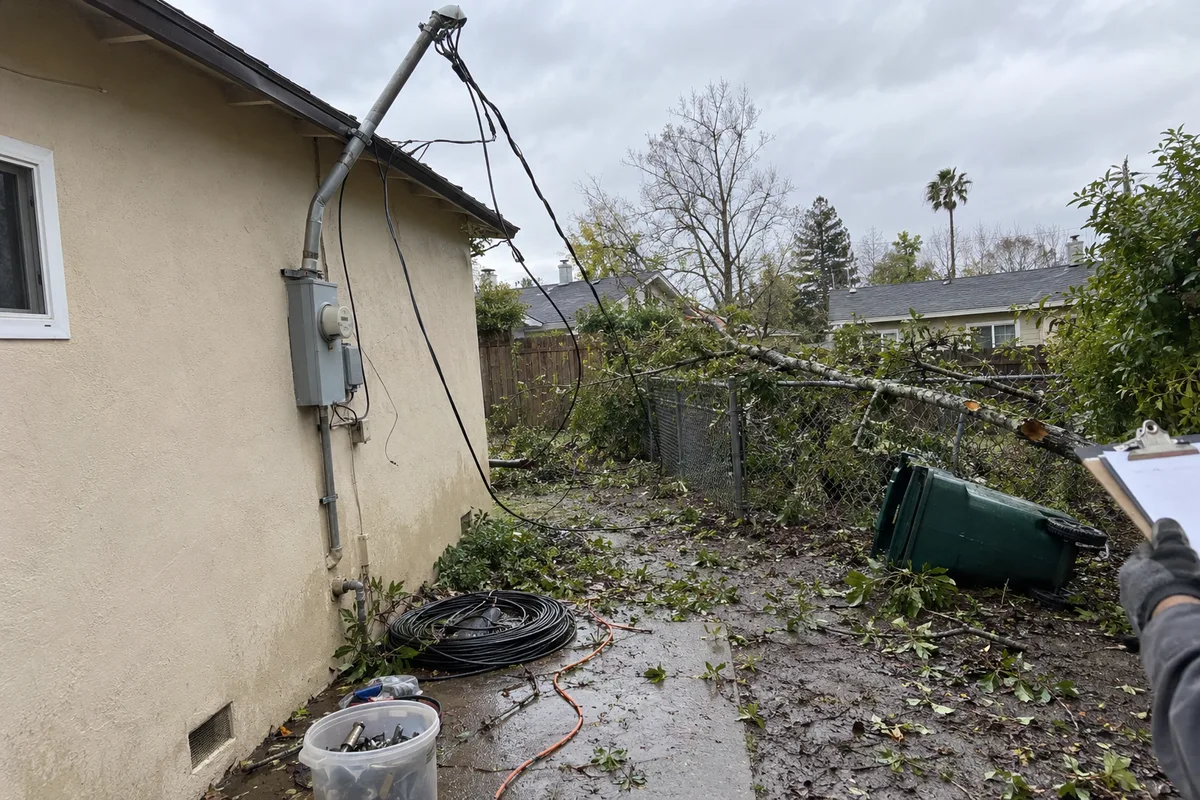
After a storm or fire, the calls may sound like “the storm pulled the line off my house” or “the fire melted the meter.” Wirewoman’s SMS summary records the problem in the caller’s own words, along with the address and how urgent it is.
That wording may tell you the job is damage “as a result of a disaster.” The address tells you whether the property sits in a county or city under a declared emergency. You still decide whether the job qualifies and whether the price is lawful.
Wirewoman answers your line 24/7. At setup, she is tuned by hand to your services, prices, and escalation rules. Within 30 seconds of hang-up, she texts you the caller’s name, address, problem in the caller’s words, urgency, and booked time. Every call is logged to a dashboard.
She quotes from the prices you gave her before an emergency. Do not give her a new storm rate after a declaration without checking it against the 10 percent rule. She does not decide whether a price is legal.
You choose which keywords mean “call me now,” including “storm,” “fire,” “line down,” and “no power.” Those calls route to your cell. The dashboard gives you a dated record of who called and what the job was.
Before January 1, 2027, write down your rates and normal markup. Preserve your supplier invoices. After a declaration, check the property, the damage, the applicable emergency window, and your price against your own pre-emergency records. For a specific job or charge, talk to your own attorney.