Short answer: the 2026 National Electrical Code (NEC), Section 110.16, drops the old rule that limited mandatory arc-flash hazard marking to service equipment rated 1000 amps or more. The requirement now reaches any equipment likely to be examined, serviced, or maintained while energized, which is a much bigger slice of what electricians actually work on. If your labeling habits were built around “only the big service gear needs a sticker,” that assumption is out of date.
What actually changed
Under earlier NEC editions, the arc-flash hazard marking requirement in 110.16 was tied largely to service equipment at or above 1000A, a threshold that excluded a lot of smaller panelboards and equipment most residential and light-commercial electricians handle every day. The 2026 edition removes that amperage cutoff and reframes the requirement around whether the equipment could reasonably be worked on while still energized. In practice, that pulls a much wider range of panels and equipment into scope.
Adoption timing isn’t uniform. States and local jurisdictions adopt NEC editions on their own schedules, so when 110.16’s 2026 language actually becomes enforceable depends on your AHJ, not a single national date. Check your state’s current adopted NEC edition before assuming the new rule already applies on a given job, but plan for it either way, the direction only moves toward broader coverage.
What the label actually has to show
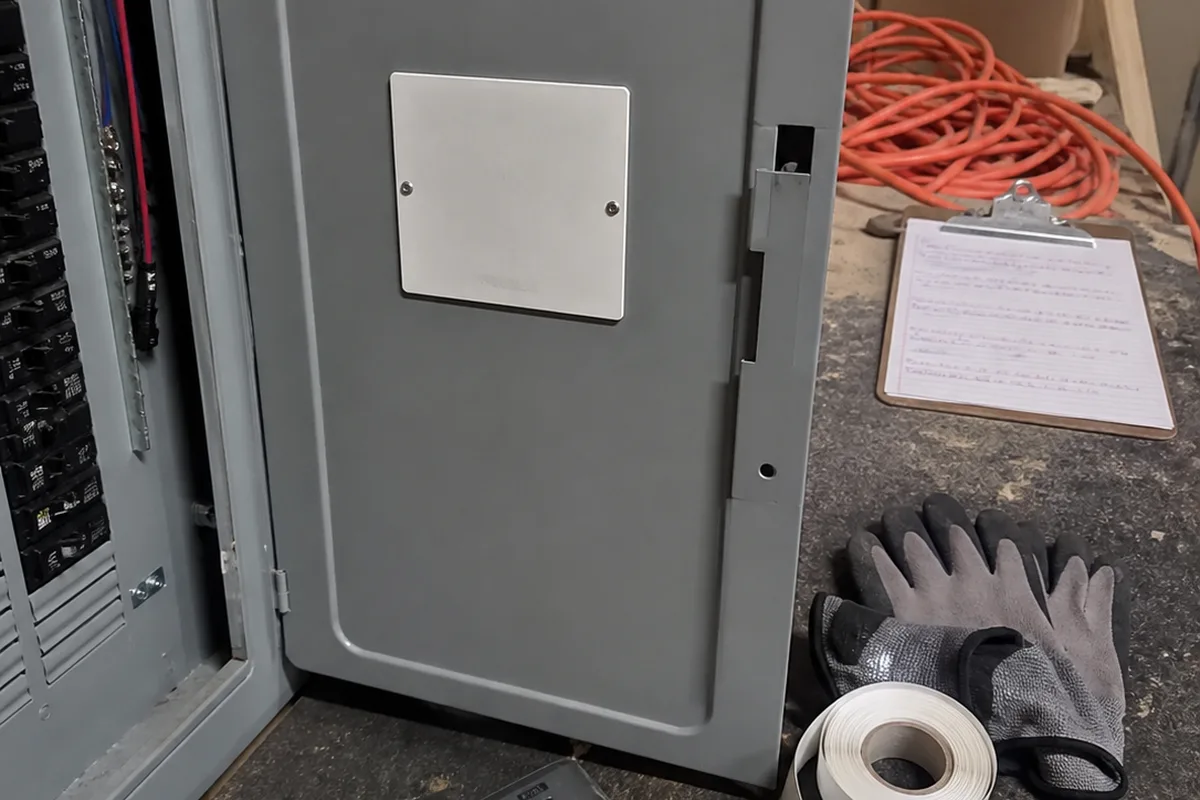
A compliant arc-flash hazard marking under 110.16 needs to communicate enough for someone to work safely without pulling the full study every time: nominal system voltage, the arc-flash boundary, and either the incident energy or the required PPE category, plus when the assessment behind the label was done. A generic “Warning: Arc Flash Hazard” sticker with no numbers on it doesn’t meet that bar. The label also has to be durable and properly field-applied under 110.21(B), not handwritten or taped on as an afterthought.
NFPA 70E is still the standard that governs how you actually calculate incident energy, select PPE, and manage safe work practices around that label once it’s up. The NEC change makes having the label a code requirement on more equipment; 70E is still what tells you what the numbers on it should be and how your crew works safely against them.
What this means for your business
- A lot of panels you already service are newly in scope. Equipment that was under 1000A and previously exempt may now need a compliant label if it’s the kind of gear that gets worked on live. Don’t assume a panel is exempt just because it was under the old threshold.
- This is a real service opportunity, not just a compliance headache. Facilities and property managers with panels that predate current labeling requirements are going to need arc-flash assessments and label updates as their AHJ adopts the 2026 code. That’s billable work, and the contractors who can explain the change accurately get asked first.
- Check what’s already on a panel before you touch it, not after. A missing or outdated label on equipment you’re about to service is worth flagging to the customer as its own line item, not something to work around silently.
- Know your jurisdiction’s adoption status. Quoting a 2026-NEC-specific requirement in a jurisdiction still enforcing an older edition undercuts your credibility as much as missing a requirement that already applies elsewhere.
The threshold that used to make this an edge case for big commercial service gear is gone. For most electricians, that turns arc-flash labeling from something you thought about occasionally into something worth checking on nearly every panel you open.
Source: NFPA, Understanding NFPA 70, National Electrical Code (NEC).