Housecall Pro costs $59, $149, or $299 per month when billed annually, depending on the plan. The monthly prices are $79, $189, and $329. The $59 headline is a one-user price.
For a California electrical shop, the two numbers that decide the real cost are the number of seats you need and the card processing fees on your revenue. Housecall Pro does not publish a per-additional-user price for Basic or Essentials, so you cannot build an accurate monthly total from the pricing page alone if you need more than the included users on either plan.
The subscription and the processing fees are the visible costs. The one that does not show up anywhere on Housecall Pro’s pricing page is the person who answers your phone, qualifies the caller, and gets the job into the software in the first place. That role exists whether or not you’ve budgeted for it.
Basic is a one-user plan, and the next seat has no published price
Basic includes one user. It costs $59 per month with annual billing or $79 per month with monthly billing.
Essentials includes five users. It costs $149 per month annually or $189 per month monthly.
Max includes eight users. It costs $299 per month annually or $329 per month monthly. Max lists additional users at $35 per month for each additional user.
The gap is on Basic and Essentials. The pricing page says “1 user included” for Basic and “5 users included” for Essentials, but it does not publish the price for additional users on either plan. You have to ask Housecall Pro directly, and you should get that number in writing before you count on it.
Count seats before you read the headline price. An owner, two technicians, and the person answering the phone already put you outside Basic. That’s the part worth sitting with: Housecall Pro’s seat count assumes a human is answering calls and opening job records, but it has no opinion on who that person is or what they cost. Front office help changes the seat count before you even open the pricing page.
Wirewoman handles that role for a flat $95-$495 a month, no seat added to the Housecall Pro count, no separate hire. She answers in about 2 seconds, 24/7, and texts a job summary to your phone in about 30 seconds after the call, so the intake work is done before anyone opens a job record. That’s a different line item than the software subscription, and it’s the one most shops forget to price.
QuickBooks Online puts the real starting point at Essentials
Basic includes online booking, scheduling and dispatch, estimates and invoicing, payments and consumer financing, price book, job costing, and review management.
Essentials adds routes, flat-rate pricing, checklist automations, photo reports and annotations, employee GPS tracking, commissions, and QuickBooks Online sync.
QuickBooks Online sync is not in Basic. If your bookkeeping runs on QuickBooks Online, your real entry price is $149 per month with annual billing or $189 per month with monthly billing. It is not $59.
Max adds a sales proposal tool listed as a $40 per month value, Recurring Service Plans, route optimization, open API access, a dedicated onboarding specialist, and escalated phone support.
Annual billing saves money, but the renewal rate is the number to budget
Basic is $79 per month when billed monthly and $59 per month when billed annually, a $240 difference over a year. Essentials is $189 monthly and $149 annually, a $480 difference. Max is $329 monthly and $299 annually, a $360 difference.
Housecall Pro says it does not require long-term contracts and that cancelling is simple. The cheaper advertised price is still tied to annual billing, and Housecall Pro also runs promotional introductory pricing on top of that. Budget the renewal rate, not the promotion.
Wirewoman’s pricing works the other direction: flat, month-to-month, no annual lock-in required to get the listed price, no per-minute meter once you’re past the lowest tier the way call-center answering services run. What you see is what renews.
Processing fees can exceed the subscription before you add another seat
Payment processing is separate from the subscription.
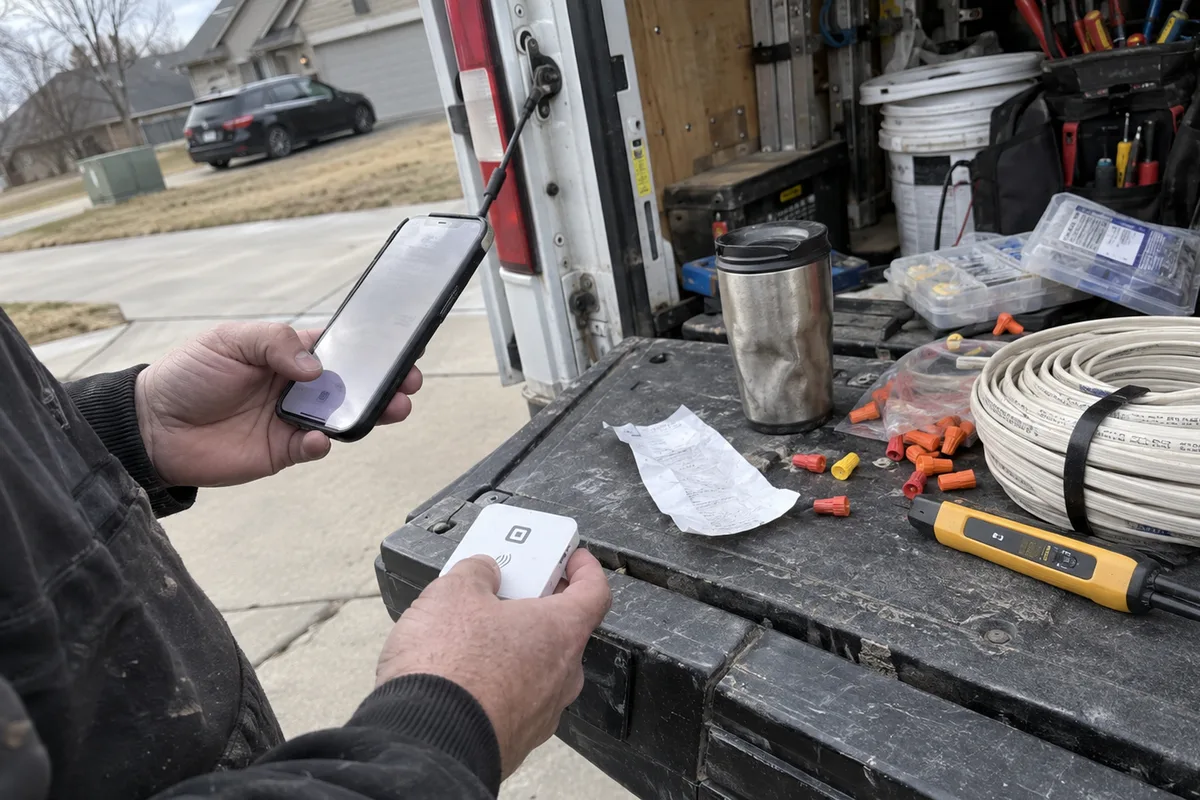
A card reader, tap to pay, swiped, tapped, or chipped transaction costs 2.59% per transaction. A customer entering a card online through the invoice costs 2.99%. Manual entry, scanned cards, and cards on file cost 3.49%. American Express and commercial, corporate, or business cards also cost 3.49%. ACH or bank transfer runs a standard 1% fee, which may vary by plan.
On $40,000 of monthly card revenue, 2.59% is $1,036. At 3.49%, the cost is $1,396. Either amount is several times the Basic subscription. On one $12,000 panel and service upgrade, 3.49% is $418.80, 2.59% is $310.80, and 1% ACH is $120.
That fee comes out of your margin. Put it inside the price you quote, just as you would with any other job cost. Your electrical job pricing needs to account for processing fees, not treat them as an afterthought.
The processing rate applies to the job once it’s booked. The bigger question for most shops is how many of those jobs never get booked at all because nobody picked up. That’s a cost Housecall Pro’s fee schedule has nothing to say about, and it’s usually larger than the spread between 2.59% and 3.49%.
The cost that never shows up on a pricing page
None of the numbers above touch who picks up the phone. That’s the gap. Housecall Pro’s seat pricing charges you for adding a person to the software, but the cost of that person, whether it’s an owner working nights, a hire, or a per-minute answering service, sits entirely outside the subscription.
A missed call has a cost too, and it’s a real number, not a hypothetical one. Every call that goes to voicemail while you’re on a roof or under a panel is a job that may book with the next electrician who answers.
Before you sign, ask Housecall Pro for the additional-user price in writing, and estimate processing cost in the same month you estimate the subscription. Then price the phone the same way you’d price a seat: what does it cost to answer every call, every time, without adding a body to your seat count? See what Wirewoman actually costs next to that math, then sign up for Housecall Pro based on the seats you will use, the QuickBooks tier you need, and the phone coverage you already have.