Short answer: an EV charging station permit in California is not a normal permit. It is a ministerial permit on a statutory clock. The building department has five business days to deem your application complete and twenty business days after that to act on it. If it does neither, the statute says your application is deemed complete and then deemed approved. Not “you can complain.” Deemed.
Most C-10s do not know this, so they eat the delay, reschedule the customer, and absorb the second trip. The two statutes that fix that have been on the books for years, and the Attorney General put every city in the state on written notice about them in March 2025.
The two statutes, and what each one does
They do different jobs and people mix them up.
Government Code section 65850.7 is the substantive rule. It came from AB 1236 in 2015 and says a city, county, or city and county “shall administratively approve an application to install electric vehicle charging stations through the issuance of a building permit or similar nondiscretionary permit.” It then limits what the reviewer is allowed to look at: review “shall be limited to the building official’s review of whether it meets all health and safety requirements.”
That is the whole scope. Not aesthetics, not neighborhood compatibility, not whether the use is listed in the zoning code. Health and safety.
The Legislature was unusually blunt about why. Subdivision (a) declares that consistent statewide standards for timely and cost effective installation of EV charging stations are a matter of statewide concern applying to all cities, including charter cities, and states the intent to prevent unreasonable barriers to installation. Charter city home rule is the usual argument a city uses to say a state permitting statute does not reach it. The statute closes that door on the first line.
Government Code section 65850.71 is the clock. It came from AB 970 in 2021 and it is the part with teeth.
The actual deadlines
Two clocks, running one after the other, with the threshold set by how many stations are on the application at a single site.
Clock one, deemed complete. If the building official has not issued a correction notice, the application is deemed complete after:
- Five business days after submission, for at least 1 but not more than 25 charging stations at a single site
- Ten business days after submission, for more than 25 charging stations
Clock two, deemed approved. If the building official has taken no action, the application is deemed approved after:
- Twenty business days after the application was deemed complete, for at least 1 but not more than 25 stations
- Forty business days after the application was deemed complete, for more than 25 stations
Add clock one to clock two and a single residential Level 2 charger, or a twelve port install at a small commercial site, is either permitted or deemed approved inside twenty five business days. Roughly five weeks on a calendar.
The section has been operative for a long time. Subdivision (f) reads: “This section shall become operative on January 1, 2022, but for every city, county, or city and county with a population of less than 200,000 residents, this section shall apply beginning on January 1, 2023.” Every jurisdiction in California has been on these clocks since the start of 2023. There is no city left that gets to say it is still ramping up.
Yes, this covers the house on your schedule tomorrow
A lot of contractors assume streamlining is a commercial charging depot rule. It is not.
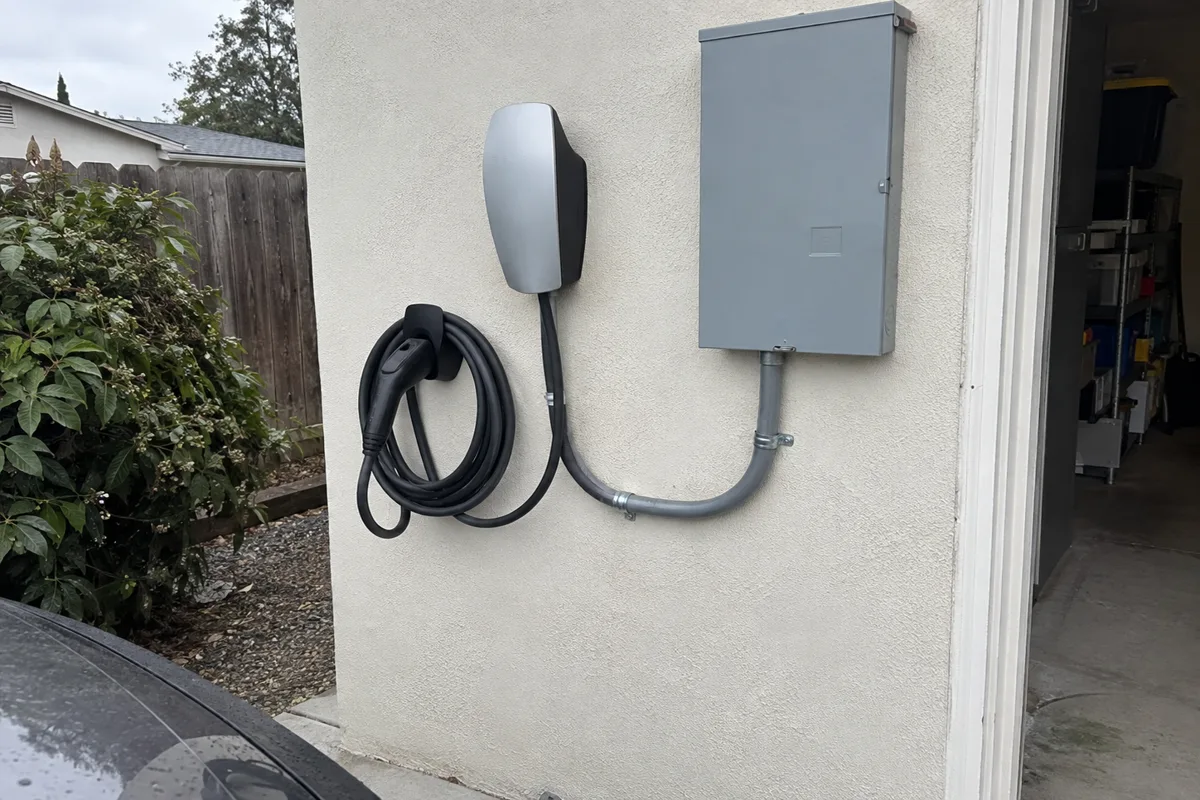
The definition in 65850.7 is equipment based, not property based. An electric vehicle charging station is “any level of electric vehicle supply equipment station that is designed and built in compliance with Article 625 of the California Electrical Code” that delivers electricity from a source outside an electric vehicle into a plug-in electric vehicle. Any level. A 40 amp wall unit in a garage qualifies the same as a DC fast charger in a parking lot.
There is no exclusion for single-family residential anywhere in either section. If you pull a permit for a home charger and the city sits on it for three weeks without a correction notice, the same statute applies that would apply to a fleet yard.
That single fact is worth more to a typical residential C-10 than everything else on this page, because home charger permits are exactly where the quiet two week stall happens and nobody pushes back.
When a city can actually say no
Very narrow, and the standard is written into the statute.
A city may not deny an application for a use permit to install a charging station unless it “makes written findings based upon substantial evidence in the record that the proposed installation would have a specific, adverse impact upon the public health or safety, and there is no feasible method to satisfactorily mitigate or avoid the specific, adverse impact.”
Take that apart, because every clause is doing work:
- Written findings. Not a phone call, not a red line on a plan set. A document.
- Substantial evidence in the record. Not the plan checker’s opinion.
- Specific, adverse impact upon public health or safety. Not traffic, not appearance, not parking supply.
- No feasible method to mitigate. Even a real hazard does not justify denial if it can be engineered around.
And if the city goes the conditions route instead of denial, subdivision (e) constrains that too: any conditions imposed “shall be designed to mitigate the specific, adverse impact upon the public health and safety at the lowest cost possible.” A city cannot use a legitimate safety concern as a hook to attach expensive unrelated requirements.
Subdivision (d) gives you the appeal path. The building official’s decision “may be appealed to the planning commission.”
The practical upshot: on a code compliant Article 625 install, a discretionary use permit is almost never lawful. If a counter tells you an EV charger needs a conditional use permit in that zone, the zoning answer is not the operative answer. The Attorney General’s March 18, 2025 legal alert says exactly this, that the streamlining laws supersede local zoning codes and cover installations regardless of siting location, and that localities must approve unless they find a specific, adverse impact upon public health or safety.
That alert is your leverage. It is a public document from the state’s chief law enforcement officer addressed to the people on the other side of the counter. Citing it is not picking a fight, it is telling a plan checker something their own city attorney would tell them.
What “deemed approved” actually gets you, and what it does not
Be careful here, because this is where a contractor can turn a good statutory right into a real problem.
Deemed approved means the application is approved by operation of law. The statute does not require you to file anything or notify anyone for it to happen, and it does not require the city to agree. Subdivision (c) conditions it on no adverse impact finding, no denial, and no appeal having been made to the planning commission.
What it does not mean is that you should go pull wire because a clock ran out and you have nothing on paper.
You still want an issued permit and a passed inspection, because that is what the customer’s insurer, their future buyer, and their utility interconnection all look for. A charger installed on an expired shot clock with no permit card and no final is a real problem for the homeowner in three years even if you were legally right today.
The honest way to use this is as escalation, not as self-help:
- Timestamp everything. Submission date, portal confirmation, every correction notice with its date. The clock is measured in business days from submission, so the submission receipt is the single most important document in the file.
- When clock one lapses, say so in writing. A short email that the application is deemed complete under Government Code 65850.71(b) as of a specific date, and that clock two is now running. Most stalls end here, because it tells the department someone is counting.
- When clock two lapses, escalate above the counter. Building official, then the city attorney’s office. Attach the AG’s legal alert. Ask for the permit to be issued consistent with the deemed approval.
- Do not start work on the theory that you won. Get the paper.
This is the same discipline as confirming what a job actually requires before you price it. Being right is worth something only if you can document it later.
Why the compliance numbers online are not worth quoting
You will find confident claims that some specific percentage of California jurisdictions are out of compliance with these laws. Be careful repeating them.
The Governor’s Office of Business and Economic Development maintains a compliance map tracking which jurisdictions have adopted the required ordinance and checklist. The numbers pulled from it move a lot depending on which year’s snapshot someone grabbed, and the categories are not clean, because “streamlining in progress” is neither compliant nor non-compliant.
More to the point, the building officials themselves dispute the map. California Building Officials issued an outreach alert to its members describing the state’s compliance map as incomplete, telling agencies to check their own status, email the Governor’s Office if the entry is wrong, and document which of the AB 1236 criteria they actually have in place. When the people being counted say the count is off, a percentage lifted from that dataset is not a number you want in front of a city attorney.
So do not lead with a statistic. Lead with the statute and your own submission timestamps. Those are facts about your job that nobody can dispute.
What you can reasonably say is the thing the AG’s office said, which is that noncompliance is widespread enough that the state issued a formal reminder to every local jurisdiction. That is the claim the record supports.
The requirement most cities have not built yet
One more that is coming, and worth knowing before your competitors do.
AB 2427 added Government Code section 65850.72, which covers charging in the public right-of-way, meaning curbside. It requires local agencies to develop a permitting checklist for right-of-way charging installations, identify the applicable fees, establish criteria for appropriate locations, publish all of it on their website, and consult the state’s EV Charging Station Permitting Guidebook.
The deadlines are staggered. Jurisdictions with 250,000 or more residents must comply by January 1, 2027. Everyone under 250,000 has until January 1, 2029.
January 1, 2027 is under four months out. Curbside charging is a category most electrical contractors have never bid because there was no path to permit it, and in the large cities that path becomes a published checklist with published fees within the year. If you work in one of those jurisdictions, the checklist is worth watching for. It is the difference between a job type that does not exist and one with a defined process.
What this means for how you bid
Permit time is a real line item on an EV charger job and most bids treat it as an unknown. It is not an unknown, it is a statutory maximum.
On a residential or small commercial install, you can tell a customer the permit is either issued or approved by operation of law within about five weeks of submission, and mean it. That changes what you can promise on scheduling, and scheduling is frequently what wins the job against a competitor who says “depends on the city.”
It also changes how you handle the stall. The two week silence from a building department that used to cost you a rescheduled crew day is now a document you send, not a delay you eat.
The thing to price honestly is the correction notice. A correction notice restarts your position, and a genuinely incomplete submittal is the city’s right, not an obstruction. The clocks reward a clean, complete first submission more than they reward arguing. Read the jurisdiction’s published checklist, which 65850.7 required it to publish, and hit every item the first time.
What to tell the people who call you
Nobody calls you about Government Code 65850.71. They call because they bought an EV, or a property manager wants chargers in a lot, or somebody told them permits take months.
The plain version for a homeowner: the city has a legal deadline to act on a charger permit, about five business days to review your application for completeness and twenty business days after that to approve it. I track those dates, and if the city runs past them I push, so this does not sit for two months.
The plain version for a property manager or a GC: charging stations get a ministerial permit, not a discretionary one. Zoning does not decide it and a use permit is almost never lawful on a compliant install. If someone told you it needs a conditional use permit, that is worth a second look before you budget for it.
And when a customer says their last electrician told them the city was the holdup, the useful answer is that the city has a clock and most people never start it running.
Those calls come in while you are in a garage with a torque screwdriver in your hand. A property manager pricing twelve ports is not leaving a voicemail about permit timelines. They call down the list until somebody picks up, and the electrician who answers with a real number instead of “depends on the city” is the one who gets the walk-through. The same thing is true of the EV charger call itself, where what you ask in the first two minutes decides whether the job is a receptacle or a service upgrade.