Short answer: since January 1, 2026, California requires GFCI protection for new residential branch circuits or outlets supplying listed appliances, including electric ranges, wall-mounted ovens, counter-mounted cooking units, microwave ovens, and clothes dryers, when they fall within the voltage and ampere limits in 210.8(D). The 2025 California Electrical Code also removed the old countertop limitation from the kitchen receptacle rule.
The 2025 CEC reaches appliances that used to sit outside the kitchen rule
California now enforces the 2025 California Electrical Code, Part 3 of Title 24. It is based on the 2023 NEC. The effective date was January 1, 2026.
The prior 2022 California Electrical Code was based on the 2020 NEC. Under the old kitchen language in 210.8(A), GFCI protection applied to receptacles installed to serve kitchen countertop surfaces. That wording did not cover every receptacle in the kitchen.
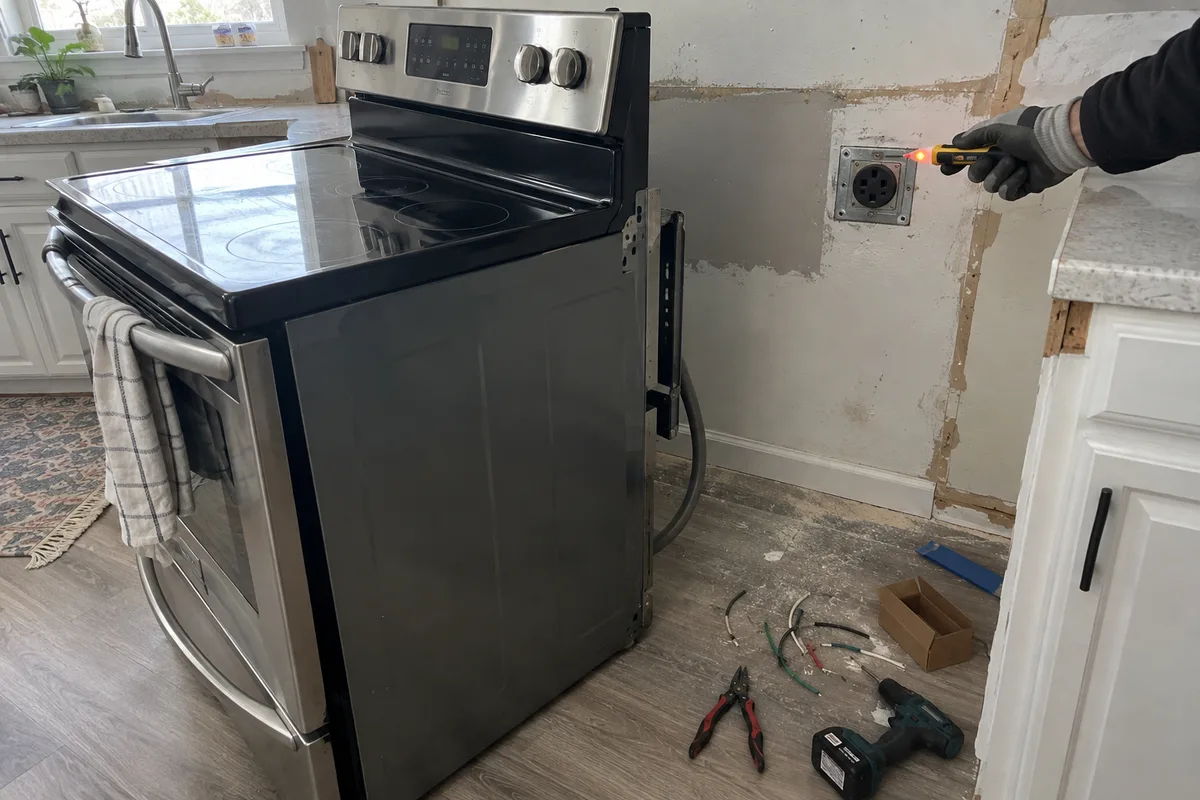
The 2023 NEC changed 210.8(A)(6). The countertop limitation is gone. Now, all 125-volt through 250-volt receptacles in a dwelling kitchen, supplied by single-phase branch circuits rated 150 volts or less to ground, need GFCI protection. A range receptacle in the kitchen is included.
California is not waiting for the 2026 NEC. The rule in force is the 2025 CEC based on the 2023 NEC. We cover that distinction in when the NEC 2026 applies in California.
210.8(D) names the range, oven, cooktop, microwave, and dryer
The new appliance rule begins with this language:
“GFCI protection shall be provided for the branch circuit or outlet supplying the following appliances rated 150 volts or less to ground and 60 amperes or less, single- or 3-phase:”
The list includes:
- Automotive vacuum machines
- Drinking water coolers and bottle fill stations
- High-pressure spray washing machines
- Tire inflation machines
- Vending machines
- Sump pumps
- Dishwashers
- Electric ranges
- Wall-mounted ovens
- Counter-mounted cooking units
- Clothes dryers
- Microwave ovens
The 2020 NEC placed the appliance list in 422.5(A). The 2023 edition moved it into 210.8(D).
The words “branch circuit or outlet” matter. This is not limited to cord-and-plug appliances. A hard-wired wall oven or hard-wired cooktop is still within the rule when it meets the stated limits.
A typical 120/240-volt single-phase residential circuit is 120 volts to ground. That is within the 150-volt limit. A 40 or 50 amp range circuit and a 30 amp dryer circuit are within the 60-amp limit.
Dryers need a precise explanation. Laundry areas were already listed locations under 2020 NEC 210.8(A), covering 125-volt through 250-volt receptacles. A dryer receptacle in a laundry area was already a GFCI location before 2026. The new rule names the dryer itself, wherever it is located and whether it is cord-and-plug connected or hard-wired.
These rules apply to new installations and work being permitted under the 2025 CEC. They do not establish a blanket requirement to retrofit existing, already-inspected ranges or dryers.
Put the GFCI device in the estimate before the inspection
For new range, wall oven, counter-mounted cooking unit, microwave, or dryer circuits, plan for GFCI protection at the breaker or outlet as required by the installation.
For range and dryer circuits, that means accounting for the applicable two-pole GFCI device instead of discovering the requirement during inspection. Put it into kitchen remodel estimates, all-electric conversions, new appliance circuits, and dryer work from the first version of the quote.
The kitchen receptacle change also affects layout discussions. The City of Benicia’s 2025 California Electrical Code Significant Changes summary identifies expanded GFCI requirements for kitchen receptacles, including hard-wired appliances like ranges and wall-mounted ovens. The same summary lists a new 210.52(C)(2) rule requiring receptacles serving islands and peninsulas to be on or in the countertop. The stated reason is to avoid appliance cords draping over the countertop edge.
That is a separate rule from appliance GFCI protection. Both can affect a kitchen remodel estimate and rough-in plan.
The code controls when a local handout uses old wording
Some local handouts have not caught up. At least one Bay Area city’s 2025 kitchen remodel handout still describes the kitchen requirement as:
“All receptacles serving kitchen countertop surfaces shall have GFCI protection [CEC210.8(A)(6)]”
That wording reflects the old countertop limitation. It does not match the expanded language in the 2025 CEC.
A city handout is a summary, not the code. When the handout and the code disagree, the code in force governs. You want the installation to match the code the inspector enforces, not just the shortest wording in a remodel flyer.
Read the actual 2025 CEC. Also check the manufacturer’s installation instructions for the specific equipment. Humboldt County’s building page specifically advises contractors to be aware of those instructions.
The new stove trip call needs one extra intake question
A new call type may sound like this:
“The new stove kills the power every time the oven preheats.”
Or this:
“The dryer shuts off halfway through.”
On Wirewoman’s text summary, the problem line appears in the caller’s own words beside the name, address, urgency, and booked time. The detail you want before rolling is whether the appliance or circuit is new. A trip on a freshly installed GFCI range circuit is a different diagnosis from a problem involving a 20-year-old breaker.
Add this intake question to appliance trip calls:
“Was the appliance or the wiring installed or replaced recently, and by whom?”
A GFCI on a range or dryer circuit is a new device in circuits that did not previously have it in every situation. A trip after a new installation is now a possibility. The trip means the device is doing the job it was installed to do until someone checks the circuit and appliance.
Wirewoman answers 24/7, books the job to your calendar, and texts the shop the job summary within 30 seconds of hang-up. Every call is logged to a dashboard. Out of the box, sparking, smoke, burning smell, and full power loss are treated as emergencies that ring the owner’s cell. A range that trips its GFCI without those warning words is booked as a normal service call instead of waking anyone up.
Each setup is tuned by hand with your shop’s own intake questions and escalation rules. You can add the recent-install question to appliance trip calls. If the caller mentions smoke or a burning smell, Wirewoman escalates under your shop’s rules. See what should and should not wake you up and questions to ask on every electrical call.
The residential code freeze makes this a long-term estimating rule
AB 130, the budget trailer bill effective June 30, 2025, placed a moratorium on new state and local residential building standards from October 1, 2025, through June 1, 2031. CBSC Information Bulletin 25-03 addresses the moratorium.
For residential work, treat the 2025 CEC GFCI rules as the working standard for years. Do not wait for the next code cycle to change your estimates.
Read 210.8(A)(6) and 210.8(D) before quoting the job. Price the required GFCI protection into range, oven, cooktop, microwave, and dryer work. Ask whether the appliance or wiring was recently installed or replaced. Keep the code in front of you when a local handout says “countertop” and nothing more. The other GFCI change affecting outdoor HVAC outlets is covered in this guide.