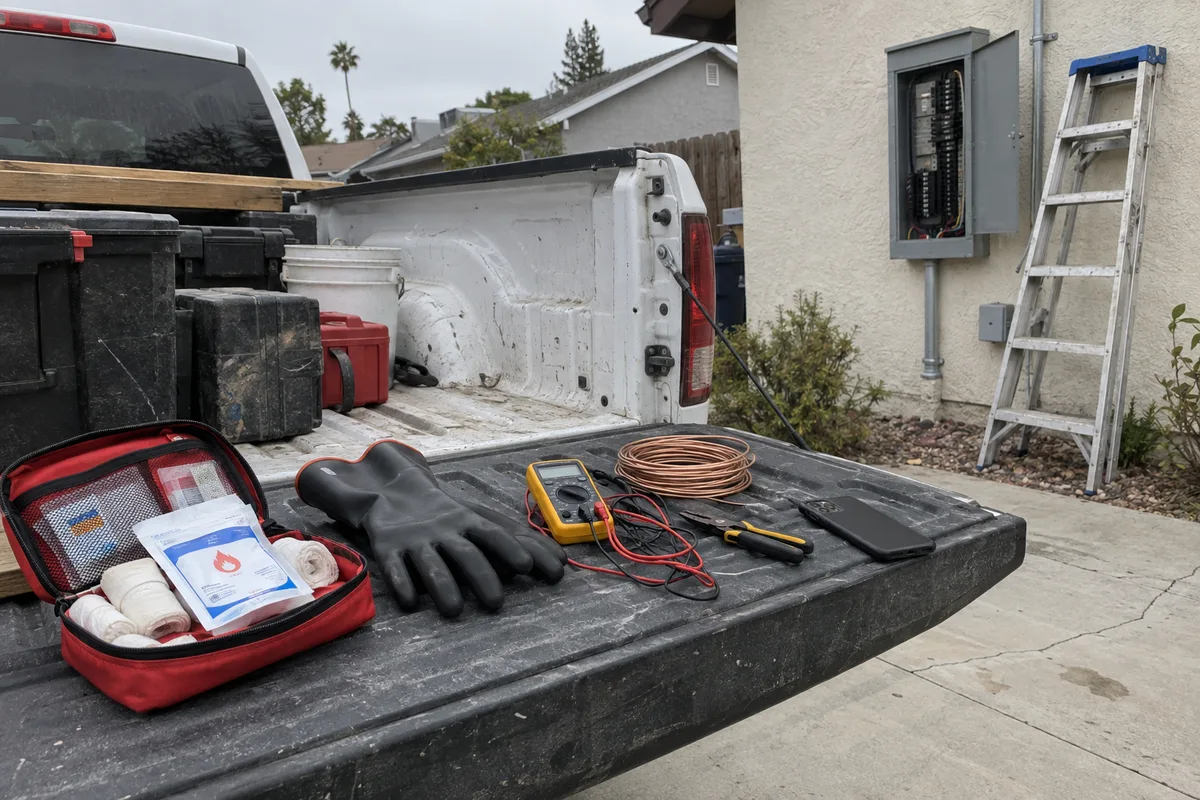
The first-aid kit in your service van is about to be measured against a new list. Cal/OSHA’s Standards Board has approved a rewrite of Title 8, Section 1512, the Construction Safety Orders section that covers emergency medical services and first aid on construction work, including electrical contracting. If the Office of Administrative Law signs off, the new rule is expected to take effect January 1, 2027.
The rewrite does three things that matter to a small electrical shop. It replaces the old supply table with a fixed kit list. It makes you decide how many kits you need based on where your people actually work. And it changes when a kit has to be checked. A separate law, AB 2150, adds naloxone training on the same date for shops that require CPR certification.
Where the rule stands
The rulemaking, titled “First Aid 2025” on the Board’s site, amends Section 1512 and its general industry twin, Section 3400. The comment period ran from November 28, 2025 to January 15, 2026, with a public hearing in Sacramento on January 15. Modified text went out for comment on May 1, 2026, and the Board took it up for adoption at its September 17, 2026 meeting and approved it.
The next step is review by the Office of Administrative Law. As of this writing, the Board’s rulemaking page does not yet show a filing date or a final effective date, so treat January 1, 2027 as the expected date, not a certainty. Either way, the changes are cheap to make now.
What stays the same
Most of Section 1512 carries over. Each employer on a multi-employer project is still responsible for emergency medical services for its own employees, and employers can still agree to run one program for the combined crew. You still need a suitable number of appropriately trained people available to give first aid, and contractors on the same project can still pool them.
Subsection (c)(1) is also unchanged. Every employer working on a construction project, on line crews, and on other short duration or transient jobs must provide at least one first-aid kit in a weatherproof container. Kit contents still have to be easy to find and sanitary, and dressings still have to be sterile in individually sealed packages.
The new kit list
The old rule scaled supplies by headcount, with columns for 1 to 5, 6 to 15, 16 to 200, and over 200 employees. That table is gone. Under the new subsection (c)(6), your minimum kit contents must either be set by an employer-authorized physician or other licensed health care professional, or match a new Table 1 that follows the Class A kit requirements in ANSI/ISEA Z308.1-2021.
Table 1 is specific. A few of its minimums: 16 adhesive bandages, 2 trauma pads, a gel-soaked burn dressing and 10 burn treatment packets, 2 eye coverings and an eye and skin wash, an instant cold pack, a foil blanket, 2 pairs of medical exam gloves, a triangular bandage, scissors, and a first-aid guide. The breathing barrier for rescue breaths or CPR has to be a single-use device listed with the FDA, and the cold pack has to get cold within 10 seconds of activation and stay cold for at least 10 minutes.
Plenty of kits on the shelf are sold as ANSI Class A. Check the contents card against Table 1 anyway, and restock to that list rather than to whatever was in the box when you bought it.
How many kits: count locations, not trucks
New subsection (c)(5) is the change most shops will feel. Based on the location of your employees and the types and severity of hazards at the jobsite, you must evaluate the need for first-aid kits and provide enough of them, and the kits must be readily available for use. Title 8 already defines readily available as a location with no obstacles to immediate use.
The Board’s final statement of reasons describes this as a hazard assessment consistent with your Injury and Illness Prevention Program under Section 3203. It also says the answer will look different when workers are spread out or isolated than when they work together. The old setup allowed a single kit on a jobsite no matter how big the project or how many people were on it.
For a service shop, a tech working alone at a customer’s house is a separate location. One kit in the shop does not cover them. Write down how you arrived at your number, the same way you keep the reasoning behind your other written plans, like the workplace violence prevention plan Cal/OSHA already expects small shops to maintain.
If Wirewoman answers your phones, you already have the raw list for this. She answers 24/7, books jobs to your calendar, texts you the caller’s name, address, problem, urgency and booked time within 30 seconds, and logs every call to the dashboard. Pull a typical week from that job log and count how many separate addresses your crews work on a given day. That count is the starting point for your (c)(5) evaluation.
When kits get checked
The old wording required the kit to be checked before being sent out on each job and at least weekly on each job. The new subsection (c)(2) says the employer must check the contents of each kit when it is put into service and at least weekly, so any used items are promptly replaced.
The Board explained why. “Job” was ambiguous, and many contractors move from job to job or structure to structure in a single day, so a check before every job did not match how the work runs and was likely to be ignored. A service van that runs several addresses in a day is exactly that case.
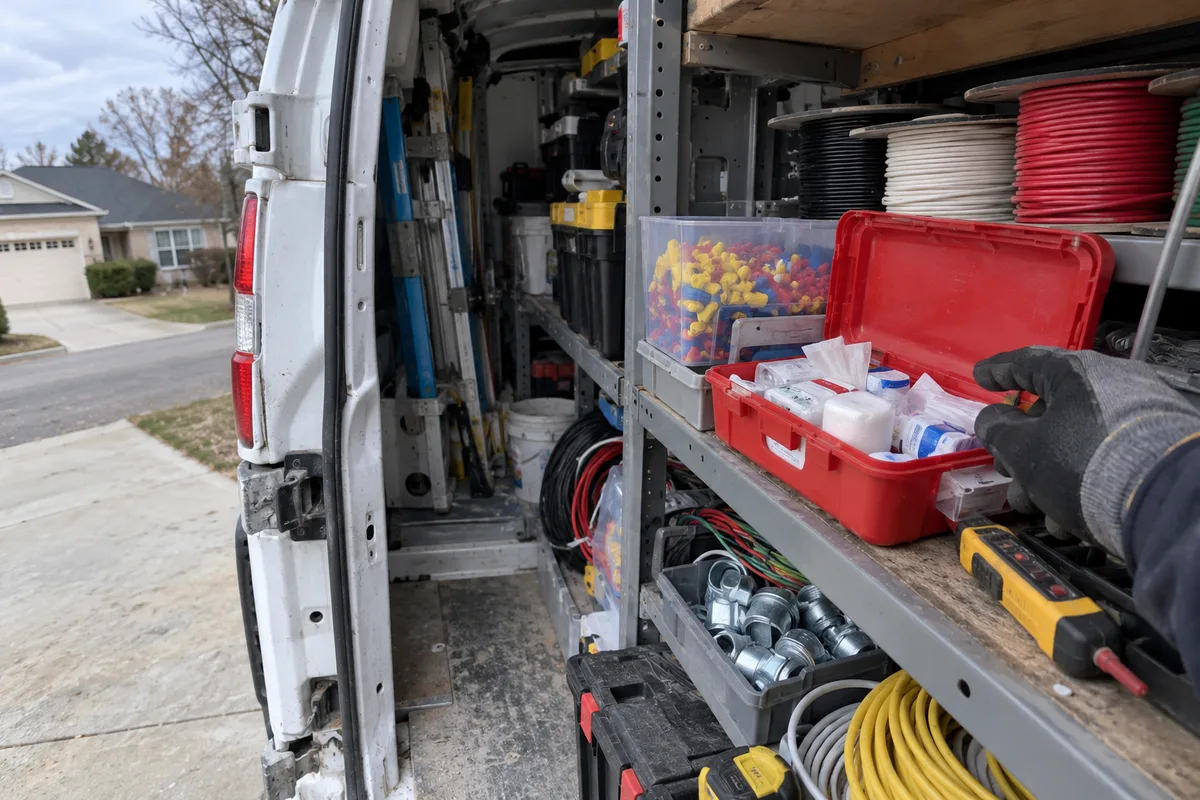
For a service shop, the natural “put into service” moment is the morning van check, when the tech is already restocking parts. If you run a daily restock like the one in our guide to what to stock in an electrician service van, add the first-aid kit to that list and log the weekly check somewhere you can show an inspector.
Tell your crew where the kit is
New subsection (c)(4) says the location of each kit must be communicated to employees and, where practicable, clearly marked with signage, labeling, or other means. The Board added “where practicable” because equipment or materials on a jobsite can block a sign, which is why telling people where the kit is matters just as much. On a van, that can be as simple as one fixed spot on every truck and a line in your new-hire walkthrough.
A missing or short kit is an easy citation to write. Our breakdown of Cal/OSHA penalties for California electrical contractors covers what those citations cost.
Naloxone: training in 2027, kits later
The Board declined to require naloxone in every workplace kit in this rulemaking and left it to each employer’s hazard assessment. That is not the end of it.
AB 2150 (Haney), Chapter 384, Statutes of 2026, adds Section 1797.197b to the Health and Safety Code starting January 1, 2027. If your shop requires employees to hold CPR certification, for example as part of your own electrical safety program, you must also require those employees to complete an online video module on using naloxone that is approved by the state Emergency Medical Services Authority. The module is separate from CPR training and has to cover recognizing an overdose, the right emergency response, and how to give naloxone. An employee whose existing CPR or first-aid training already meets that standard can count it, as long as you keep the documentation. The training does not create a duty to administer naloxone.
This only applies if your shop requires CPR cards. It is not a new rule that every electrician must be CPR certified. If you do require them, keep completion records alongside the cards, the same way you document other required training such as Cal/OSHA’s energized work rules.
The kit requirement is still coming. AB 1976 (Haney), Chapter 689, Statutes of 2024, requires Cal/OSHA to send the Board a draft rule before December 1, 2027 that adds naloxone or another FDA-approved opioid antagonist, plus instructions, to workplace first-aid materials under Sections 1512 and 3400. Cal/OSHA also has to consider storage guidance based on the manufacturer’s instructions, which matters for a kit that lives in a hot van. The Board must consider adopting it by December 1, 2028. Construction is not a side issue here: the Senate Labor Committee’s analysis of AB 1976 quoted Cal/OSHA’s Opioid Hazard Alert reporting that unintentional overdoses caused over 100 workplace deaths in California in 2022, 22% of all workplace fatalities in the state that year.
Before January
Count kits by where people work, not by your shop address. Restock every kit to Table 1 or have a licensed health care professional set your contents. Add the kit to the morning van check and log a weekly check. Tell every employee where the kit is on each truck and site. If you require CPR cards, plan for the naloxone module and keep the records. Then watch for the AB 1976 draft before the end of 2027.
Read the final text of Section 1512 once it is filed. This is general information, not legal advice.