TL;DR: A knob-and-tube call is not automatically a simple inspection. Ask who needs the paper, whether the wiring is live, whether insulation is already planned, and which city or county governs the property before you quote the job.
A knob-and-tube letter can become a signed certification
A homeowner may say, “Can you sign off on my knob-and-tube?” That wording hides the real job.
You may be asked to survey existing wiring, select one of three certification outcomes, sign your name, write your California license number, and send the form to a building department. The result may affect insulation work, a home sale, an insurance application, or a mortgage.
That is not the same as looking at a few accessible wires and saying they seem fine.
Ask first: “Who is asking for this paper?”
The answer usually falls into one of four groups:
- An insurer or insurance broker
- A city building department or inspector
- An insulation contractor
- A buyer or lender in escrow
Each one may need a different document and may be working against a different deadline. Do not quote the job before you know which one is involved.
On Wirewoman’s intake, “Who is asking for this?” is asked as a plain question. The answer lands in the SMS job summary and the call log on the dashboard. You see “insurer wants a letter, closing in escrow” before calling back, not after rolling a truck.
That one answer changes the call.
Ask whether the wiring is live before discussing insulation
Your next question is direct:
“Is the wiring still live, partly disconnected, or already removed?”
Those answers map to the three electrician certification checkboxes on the City of Menlo Park form, “Knob and Tube Safety Requirements for Attics”:
- The existing wiring is in good condition, with no evidence of deterioration, proper overcurrent protection, and no improper connections or splices.
- The wiring is not in good condition and may not be covered without repair or rewiring.
- The wiring is disconnected and not live, or has been removed.
The caller may not know which answer is correct. That is your point. You are sorting the visit, not accepting the homeowner’s conclusion over the phone.
If the homeowner says the wiring was “taken out,” ask whether it was fully removed or simply disconnected. If it is partly disconnected, do not treat that as the same condition as wiring that is not live throughout.
The form requires the electrician to write a name, company, license number, address, signature, and date. That makes the condition you document part of a signed professional record.
A clean letter is not guaranteed. Say that on the call.
The price of the visit is for the survey, not for a favorable outcome. The visit may end with “not in good condition” and a rewire quote.
That expectation protects the schedule and prevents a homeowner from treating the appointment as a promised approval.
Ask whether insulation is already installed or about to be blown in
Then ask:
“Is insulation already over the wiring, or is someone about to blow it in?”
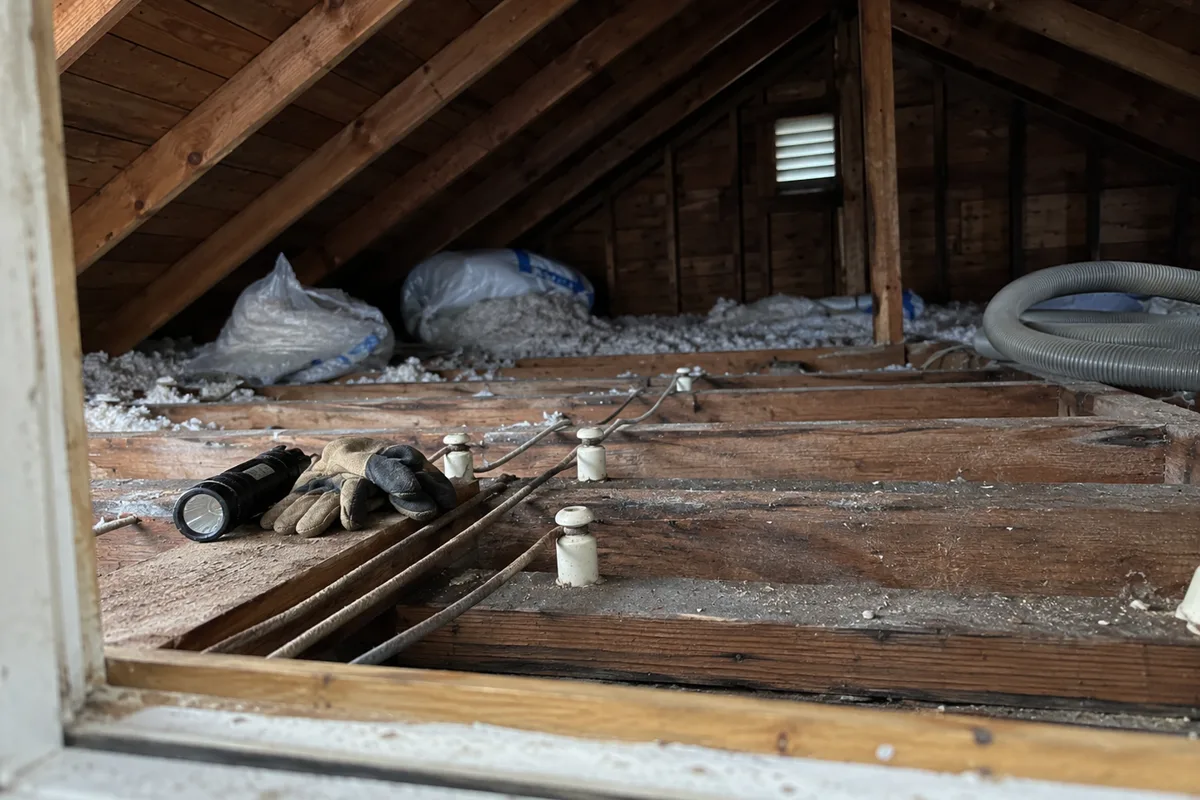
The timing matters. If insulation is planned, the electrical survey must happen before the insulation crew covers the work.
NEC Article 394 addresses concealed knob-and-tube wiring. Section 394.10 permits concealed knob-and-tube in hollow spaces of walls and ceilings, or in unfinished attics and roof spaces, only for extensions of existing installations. Elsewhere, special permission is required.
Section 394.12 lists uses that are not permitted. Item (5) covers hollow spaces of walls, ceilings, and attics where loose, rolled, or foamed-in-place insulation envelopes the conductors.
The reason commonly given is straightforward. This wiring relies on free air to shed heat. Insulation around the conductors can raise conductor temperature, which can lead to insulation breakdown and ignition.
If an insulation crew is waiting, a survey after the insulation is installed creates a different access problem. If the insulation is already in place, the electrician needs to know that before the appointment is booked.
Ask who is scheduling the insulation and whether the caller has the building department’s requirements in writing. Do not let “the insulation company said you only need a letter” replace the actual form or department instruction.
For related intake discipline, use the same front-end approach described in Questions to Ask on Every Electrical Call. The first call should identify the requested document and the condition that controls the work.
The property’s city or county decides which form you check
Ask:
“What city or county is the house in?”
Do not assume that one California city’s form applies somewhere else.
The City of Menlo Park, California Community Development publishes a form called “Knob and Tube Safety Requirements for Attics.” It cites California Electrical Code section 394.12(5), 2025. Under its residential exceptions, insulation over knob-and-tube is not allowed unless several requirements are met.
The wiring must be surveyed and certified by an electrical contractor licensed by the State of California as being in good condition, with no evidence of deterioration, proper overcurrent protection, and no improper connections or splices.
Repairs, alterations, or extensions to the existing system require permits and inspections.
The certification form goes to the building department, with a copy to the property owner. Printed caution notices in English and Spanish must be posted at all access points.
The insulation must be noncombustible as defined in California Code of Regulations Title 24. It also cannot have electrically conductive material as part of it or supporting it.
The building department may still require permits and inspections for the insulation itself. The letter must be filed with the city and posted in the attic before inspection.
Those are Menlo Park’s published requirements. Other California cities and counties set their own paperwork. Ask for the building department’s own form before quoting. Check with that department before you tell the caller what the finished package will be.
This is the same reason a home inspection report should not be treated as a complete job description. The report may identify the issue, but the authority asking for your work controls what it will accept. See Home Inspection Report Calls for Electricians for that intake problem.
Insurance calls have a different paper trail
If the caller says an insurer or broker needs the certification, ask what the insurer specifically requested and ask for the written request.
ABC7 News reported on March 13, 2025, that Bay Area insurers were denying or canceling homeowner policies over knob-and-tube wiring. The report quoted insurance broker Jerry Becerra of Heffernan Barbary Insurance Services: “If we put it on the application, we are going to get declined.”
ABC7 also reported that without standard coverage, lenders will not approve a mortgage unless the buyer pays for the California FAIR Plan.
That is one news report, not a statewide rule. Insurer requirements differ by company. Do not tell a caller that every insurer will reject the property, or that one electrical certification will satisfy every insurer.
Ask whether the caller is applying for coverage, responding to a non-renewal, or trying to close a loan. Ask whether the insurer wants a signed electrician letter, a completed city form, proof of repair, or something else.
The same wiring condition can produce different paperwork depending on who is asking. An insurer may be focused on the application. A lender may be focused on required coverage before closing. A city may be focused on its own permit or inspection file. Your license number on a signed certification is not a substitute for asking which document the recipient will accept.
Insurance-driven callers may phone after hours or during a lunch break, right after reading a non-renewal letter. Wirewoman answers 24/7, captures who is asking and what the caller needs, books to the shop’s calendar, sends the job summary by SMS within 30 seconds after the call ends, and logs every call to a dashboard.
That gives you the request before the callback. It does not turn an insurer’s requirement into a code requirement, and it does not promise the caller a clean result.
Hazard symptoms change the call type
Ask one more question before treating this as paperwork:
“Any burning smell, warm outlets, or buzzing?”
A yes changes the call. This is a hazard call, not a certification call.
Do not let the homeowner bury a safety symptom inside a request for an attic letter. The paperwork can wait while the hazard is handled through your electrical emergency triage process.
The same applies when the caller says the wiring is live but cannot describe where it runs, or when the homeowner believes insulation has already covered active conductors. Capture the answer in the call record and set the appointment type from the condition reported, not from the caller’s label for the job.
Your after-hours rules should spell out what happens next. See The After-Hours Call Policy Every Electrical Shop Needs. A phone answer that only writes “knob-and-tube inspection” on the calendar leaves out the facts that control urgency and scope.
Quote the survey, not the outcome
Your intake order should be:
- Who is asking for the paper?
- Is the wiring live, partly disconnected, or removed?
- Is insulation already over it, or is insulation about to be installed?
- What city or county is the property in?
- What form or written request did the caller receive?
- Does the caller understand that the survey may result in a repair or rewire quote?
- Are there burning smells, warm outlets, or buzzing?
Then confirm the appointment type and the records the caller should provide.
Do not quote from the phrase “sign off.” Do not assume the Menlo Park form applies outside Menlo Park. Do not promise a clean letter. Do not let an insulation crew cover the wiring before the electrical survey if the survey is needed first.
Change the intake script so the shop asks these questions in this order. Make “who is asking for this?” a required field in the phone system. Ask for the jurisdiction’s form before you price the visit.
That is how you separate a survey, a repair, a rewire, a city filing, an insurance request, and a hazard call before a truck is sent.